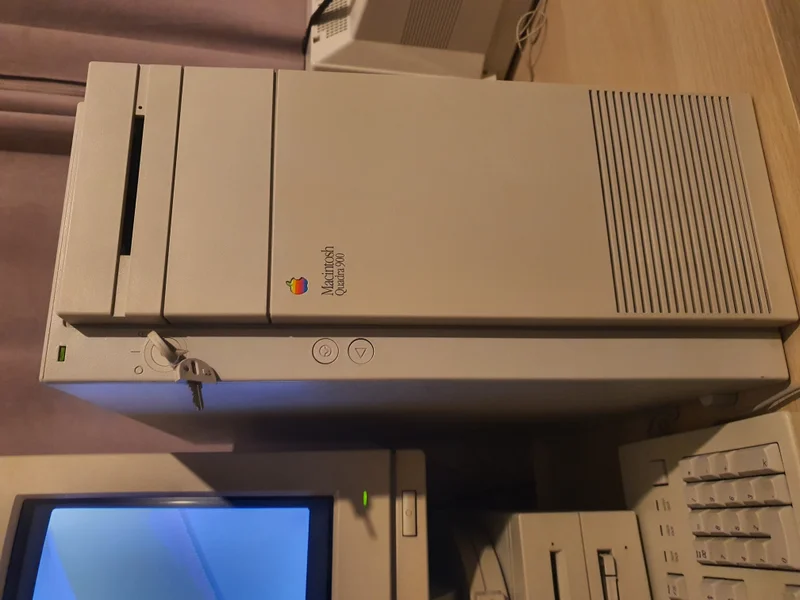
Macintosh Quadra 900
Apple's top workstation with tower design and massive RAM expandability. Used in video production and scientific computing.
The Quadra 900 shipped the same morning as the 700 with the same 68040 at 25MHz and a completely different idea about what a professional machine should look like. The 700 was a low box. The 900 was a tower. Five NuBus slots, room for several internal hard drives, a proper power supply, and a lockable door across the front, which tells you Apple was selling into places where people worried about who could open the case. Ethernet and color video came across from the 700. What the bigger chassis added was cooling and room, and that combination found an audience in desktop video just as the field was becoming possible. Avid and the other early NuBus capture and editing cards wanted a machine you could fill with hardware and then keep running, and the smaller Quadras could not do it as gracefully. Reviewers liked the speed, which was the 700's speed, and singled out the drive bays and the locking door as evidence Apple understood institutional buyers. Broadcast facilities, universities and corporate IT departments bought them. The Quadra 950 replaced it a year later with a faster clock in the same chassis, and this shape was the high point of Apple's NuBus tower before PowerPC changed everything.
Mac History Timeline
Full Specifications
Availability
Processor
Memory
Storage
Display
Graphics
Expansion
Connectivity
Physical
Processor Deep Dive
Motorola 68040
MotorolaThe Quadra 900 used the same 25MHz 68040 debuting in the Quadra 700, with its integrated floating-point unit, memory management unit, and dedicated instruction and data caches delivering a major performance leap over the previous 68030 generation. In the Quadra 900's larger tower chassis, the chip benefited from superior cooling and a more robust power supply, well suited to sustained heavy workloads like video capture and multi-card professional configurations. Its architecture represented the practical performance ceiling of the classic 68k family before Apple's PowerPC transition. The same processor generation would go on to power the entire first wave of Quadra-branded machines across Apple's professional lineup.
Compatible Operating Systems

System 7.0.1
Launch OS1991
Shipped with the Quadra 900, tuned for its 68040 and multi-slot tower architecture.
System 7.1
Compatible1992
Improved 68040 compatibility and stability for professional workstation configurations.
System 7.6.1
Max Supported1997
The realistic ceiling for a well-equipped Quadra 900 with maximum RAM installed.
Reviews & Reception
Praised as Apple's premier workstation of its era, especially valued in video production and institutional settings for its power and expandability.
The Quadra 900 is Apple's most serious workstation yet, combining blistering 68040 performance with room to grow that professional video studios will appreciate.
Five NuBus slots and a lockable front panel show Apple is finally taking institutional and broadcast customers seriously.
For desktop video production, the Quadra 900's expansion room and raw power make it the clear choice among Mac workstations.
A superb but expensive machine, clearly aimed at facilities and institutions rather than typical small business buyers.