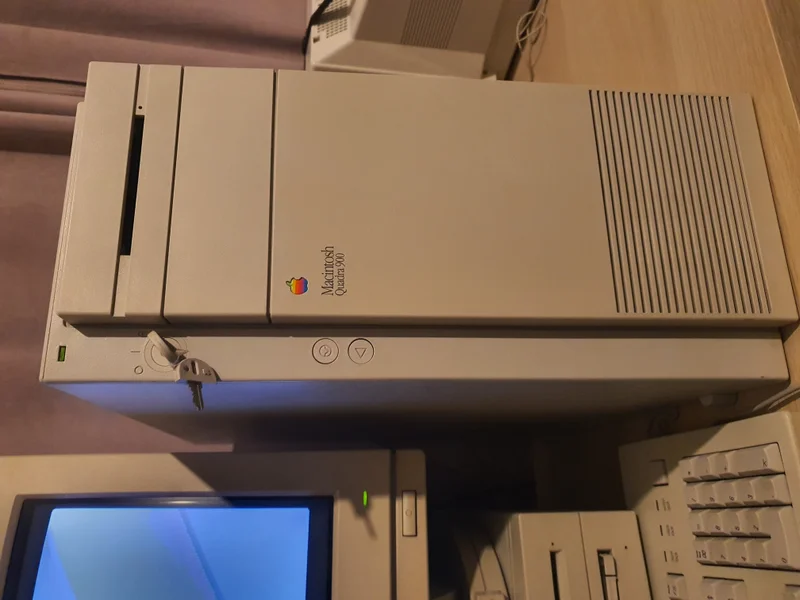
Macintosh Quadra 800
Popular mid-range 68040 tower. Excellent performance for the price in 1993.
The Quadra 800 shipped February 10, 1993 and is the one people still name as the best 68040 Mac Apple built. A 68040 at 33MHz. The speed came from more than the clock, because Apple had redesigned the system architecture around it and given it a faster SCSI implementation, which is why the 800 beat earlier Quadras that looked comparable on paper. The case was new and much smaller than the Quadra 900 and 950 towers, with dual SCSI buses, Ethernet on the board and room for up to 136MB of RAM. Publishers, video editors and audio people took to it immediately, since it gave them most of a Quadra 900 in something that fitted beside a desk and cost considerably less. Reviewers made the price-to-performance argument in every writeup and called it the smart buy. Against PC workstations it held up well in publishing and multimedia, where QuarkXPress, Photoshop and the early digital audio tools all ran on the Mac first. The compact case made internal work fiddlier than the big towers, and NuBus was starting to look slow as video capture demanded more bandwidth. Apple's Quadra naming had become genuinely confusing by this point too. It sold well regardless. PowerPC made the entire 68k line legacy hardware about a year later.
Mac History Timeline
Full Specifications
Availability
Processor
Memory
Storage
Display
Graphics
Expansion
Connectivity
Physical
Processor Deep Dive
Motorola 68040
MotorolaThe 68040 was Motorola's most advanced 68000-family chip, integrating a floating-point unit and separate instruction and data caches directly on-die, delivering roughly double the performance of the 68030 clock-for-clock. Running at 33MHz in the Quadra 800, it gave Apple's mid-range tower workstation-class number-crunching and graphics performance. It was broadly competitive with contemporary RISC-adjacent designs in real-world desktop publishing and multimedia tasks. The 68040 represented the high-water mark of the classic Mac CISC era just before PowerPC's 1994 arrival.
Compatible Operating Systems

System 7.1
Launch OS1993
Shipped as the Quadra 800's original factory operating system.
System 7.5
Compatible1994
Ran very well thanks to the Quadra 800's ample RAM ceiling and fast 68040 processor.
Mac OS 7.6.1
Compatible1997
One of the last major releases fully supporting 68040 Quadra towers like the 800.
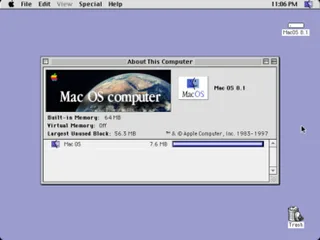
Mac OS 8.1
Max Supported1997
Could run in a limited, unofficial capacity but was not well optimized for 68k hardware, marking the practical ceiling.
Reviews & Reception
The Quadra 800 was broadly celebrated as the best price-to-performance Quadra of its generation.
The Quadra 800 delivers nearly flagship performance in a smaller, more affordable box, making it the smartest Quadra purchase available.
Publishing professionals will find the 800's speed and onboard Ethernet a genuine productivity boost over older 68030 towers.
A remarkably well-balanced workstation that undercuts the Quadra 900 on price without sacrificing much real-world speed.
The compact case trades away some of the expandability power users crave, but for most professionals the tradeoff is worthwhile.