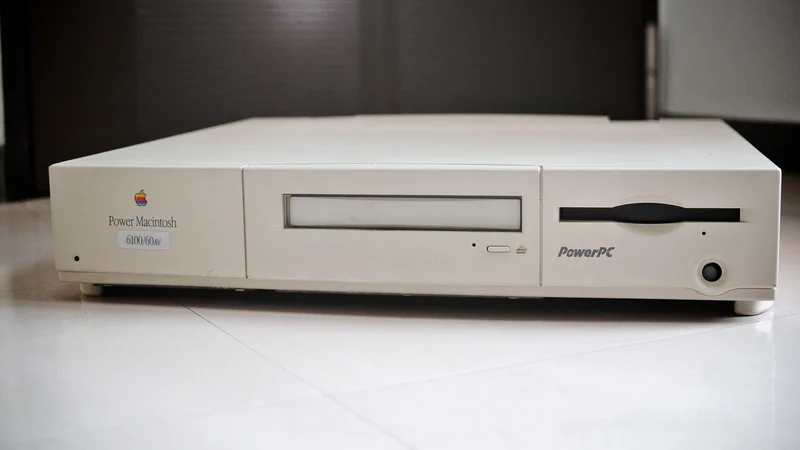
Power Macintosh 8100
Top of the first Power Mac line. A powerhouse for digital publishing and video production.
The 8100 sat at the top of the first PowerPC trio, a 601 at 80 or 110MHz in a tower with NuBus slots, drive bays and room for serious RAM. Native PowerPC software on the 110MHz configuration produced benchmark numbers that got the industry's attention, frequently beating Pentium systems of the same year on real creative work rather than synthetic tests. That mattered, because Apple needed to prove the architecture change bought something and not merely parity with the Quadras it replaced. Publishing houses, prepress shops and early digital video people bought them. Those were exactly the customers with years of NuBus cards and SCSI peripherals to protect, and the tower kept all of it working. Reviewers were impressed and honest about the caveat. Native code flew. Emulated 68k software, which in March 1994 was still most software, ran acceptably and showed none of the advantage. It cost what a flagship costs. For the people buying it, RAM-hungry and computation-heavy work paid that back quickly enough that the price was not really the question.
Mac History Timeline
Full Specifications
Availability
Processor
Memory
Storage
Display
Graphics
Expansion
Connectivity
Physical
Processor Deep Dive
PowerPC 601
IBM/Motorola (AIM alliance)The 8100 shipped with the fastest PowerPC 601 configurations available at launch, 80MHz and later 110MHz, the product of the Apple-IBM-Motorola AIM alliance's ambitious push to challenge Intel with a modern RISC design. Its efficient unified execution core delivered class-leading performance on native PowerPC applications, frequently besting contemporary Pentium systems in professional creative workloads. As the flagship configuration of the chip across Apple's first PowerPC generation, the 601 in the 8100 demonstrated the architecture's genuine workstation-class potential. Its success helped validate PowerPC as a long-term platform rather than a risky one-off experiment.
Compatible Operating Systems

System 7.1.2
Launch OS1994
Shipped as the flagship 8100's original PowerPC-enabled operating system.
System 7.5
Compatible1994
Ran excellently, taking full advantage of the 8100's fast processor and expandable RAM.
Mac OS 7.6.1
Compatible1997
Fully supported and performed strongly given the 8100's high-end 601 configuration.
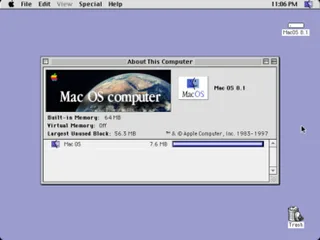
Mac OS 8.1
Max Supported1997
The practical ceiling for this Old World ROM machine, as later Mac OS releases required New World ROM support.
Reviews & Reception
The Power Mac 8100 was hailed as a flagship triumph, proving PowerPC could deliver genuine workstation-class performance for demanding professionals.
The Power Mac 8100 delivers workstation-class performance that finally makes the PowerPC transition feel like an unambiguous win for professionals.
In native benchmarks, the 8100 outpaces comparable Pentium systems, a genuine achievement for Apple's new architecture.
Digital publishing houses will find the 8100's speed and expansion room exactly what they've been waiting for.
A superb flagship machine, though its premium price keeps it firmly in professional rather than mainstream territory.