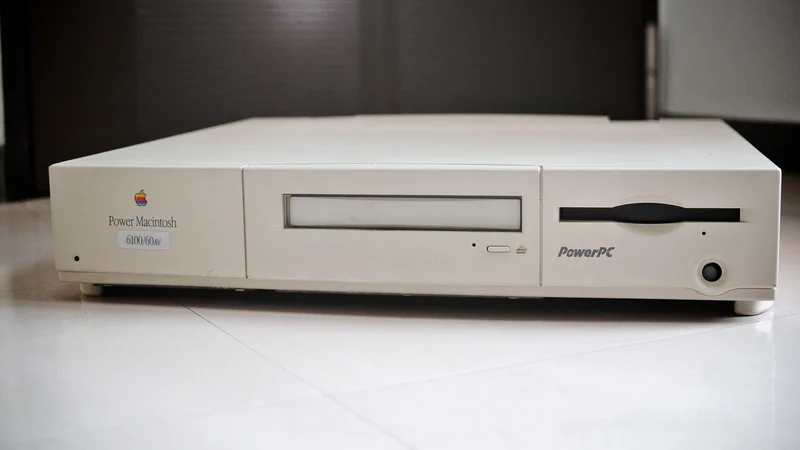
Power Macintosh 6100
First Power Macintosh. Marked Apple's historic transition from Motorola 68k to PowerPC architecture.
On March 14, 1994 Apple bet the company on a new processor architecture, and the 6100 is where it started. The PowerPC 601 ran at 60 or 66MHz, designed by Apple, IBM and Motorola together, and it was a RISC chip replacing a CISC one, which meant every piece of Mac software in existence had been compiled for the wrong instruction set. Apple solved that with emulation. System 7.1.2 shipped with a 68k emulator that ran existing applications without recompiling, slower than native but acceptably so, and that is the whole reason the transition worked. Software rebuilt for PowerPC, early Photoshop among it, ran startlingly fast and showed people what they were buying. The 6100 was the cheap one, in a low pizza-box case aimed at homes, small businesses and the curious. Reviewers liked the native benchmarks, then pointed out that most users would spend most of their time in emulation, where the gains were a great deal more modest. Against Intel's year-old Pentium the 601 held up, and Apple put that in the advertising. The case felt cheap next to a Quadra, NuBus was already dated, and some configurations still used caddy CD-ROM drives. None of that is why it matters. Apple changed processor architectures without stranding its software, which plenty of people had said could not be done, and the company ran the same playbook again for Intel in 2006 and Apple Silicon in 2020.
Mac History Timeline
Full Specifications
Availability
Processor
Memory
Storage
Display
Graphics
Expansion
Connectivity
Physical
Processor Deep Dive
PowerPC 601
IBM/Motorola (AIM alliance)The PowerPC 601 was the first fruit of the AIM alliance, a joint venture between Apple, IBM, and Motorola formed specifically to challenge Intel's x86 dominance with a modern RISC architecture. Running at 60 or 66MHz in the Power Mac 6100, it combined integer, floating-point, and branch execution units on a single chip and offered performance competitive with, and in some benchmarks superior to, contemporary Intel Pentium processors. Its RISC design represented a fundamental architectural break from the Motorola 68000 family, requiring an emulation layer for legacy software while unlocking dramatic speed gains for native applications. The 601's success validated the AIM alliance's strategy and launched a PowerPC lineage that would power Macintosh computers for over a decade.
Compatible Operating Systems

System 7.1.2
Launch OS1994
A special PowerPC-enabled release, this shipped as the original operating system on the Power Mac 6100.
System 7.5
Compatible1994
Ran well and added broader native PowerPC support alongside continued 68k emulation.
Mac OS 7.6.1
Compatible1997
Fully supported and reasonably performant thanks to the 601 processor's solid PowerPC foundation.
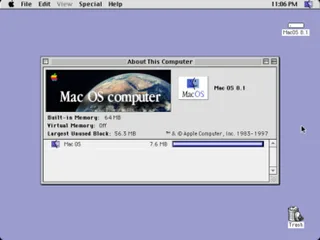
Mac OS 8.1
Max Supported1997
The practical ceiling for Old World ROM 601 Macs, with Mac OS 8.5 and beyond requiring New World ROM architecture.
Reviews & Reception
The Power Mac 6100 was recognized as a historic and largely successful first step in Apple's ambitious PowerPC transition.
The first Power Macintosh proves Apple can reinvent its processor architecture without breaking the software its customers depend on.
Native PowerPC applications show remarkable speed gains, though the current software library remains thin at launch.
Apple's new RISC chip holds its own against Intel's Pentium in several benchmarks, a genuine surprise to the PC industry.
Emulated 68k software runs acceptably but noticeably slower than native code, an inevitable growing pain of this ambitious transition.