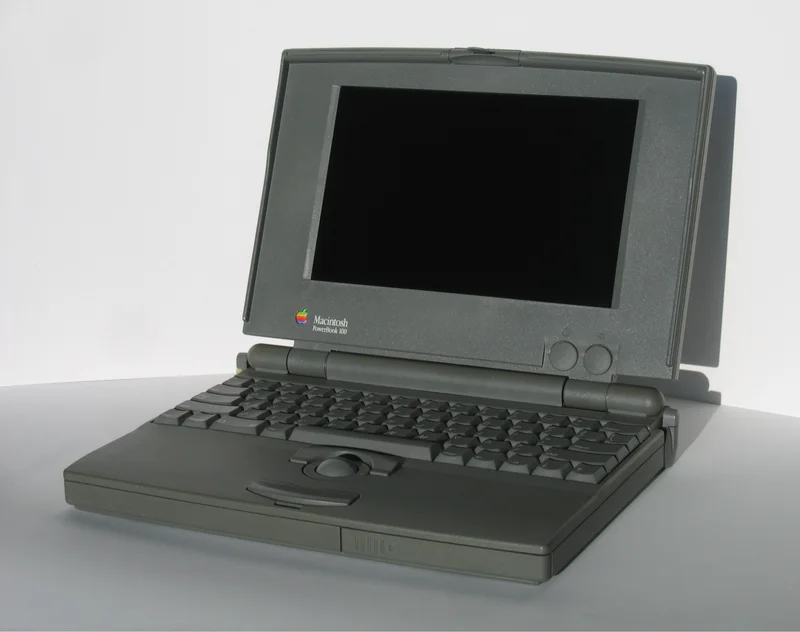
PowerBook 140
Mid-range PowerBook with 68030 chip. Middle ground between the 100 and 170.
The 140 sat in the middle of the first PowerBook trio, which is where most of the sales were. Same chassis as the 100 and the 170, same rear keyboard and centered trackball, with a 68030 at 16MHz rather than the 100's 68000. That processor was the reason to buy it. Fully 32-bit clean, with proper virtual memory support, which mattered because System 7 had shipped months earlier and was hungry. The 100 could not really keep up with it. The screen was where Apple saved the money. A 9.8-inch monochrome passive-matrix panel, with the ghosting and slow response those had, well short of the active-matrix display in the 170. It cost less and drew less power, which was the trade. Reviewers called it the sensible one. Business travelers and consultants who needed to run real applications away from a desk bought it in preference to the 100, and in preference to paying the 170 premium for a better panel. The October 1991 launch as a whole rescued Apple's portable ambitions after the Macintosh Portable had gone badly two years earlier, and the 140 was the volume seller in it.
Mac History Timeline
Full Specifications
Availability
Processor
Memory
Storage
Display
Graphics
Expansion
Connectivity
Physical
Processor Deep Dive
Motorola 68030
MotorolaThe PowerBook 140 used a 16MHz 68030, a full 32-bit-clean implementation with an integrated memory management unit that made it considerably more capable and future-proof than the PowerBook 100's 68000. This let the 140 properly support virtual memory and run System 7 features more comfortably than its entry-level sibling. Running at the same clock speed as the desktop SE/30 and Mac IIx, the 140 offered genuinely competitive desktop-class performance in a portable form factor, a significant achievement for 1991 laptop engineering. It represented Apple's successful adaptation of its most important desktop processor generation into a viable mobile power envelope.
Compatible Operating Systems

System 7.0.1
Launch OS1991
Shipped with the PowerBook 140, fully exploiting its 32-bit-clean 68030.
System 7.1
Compatible1992
A popular and stable release for PowerBook 140 owners.
System 7.5.5
Max Supported1996
The realistic ceiling for a well-equipped PowerBook 140 with maximum RAM.
Reviews & Reception
Well regarded as the practical, value-oriented middle choice of the first PowerBook generation, offering real 68030 performance at a more accessible price.
The PowerBook 140 strikes the ideal balance between price and performance, giving road warriors real 68030 power without the 170's premium cost.
The passive-matrix screen shows some ghosting during fast scrolling, but the overall package remains an excellent value for traveling professionals.
A genuinely capable desktop-class machine you can take on the road, the 140 is likely to be the volume leader of Apple's new portable lineup.
Business travelers will appreciate the real computing power here, even if the screen quality trails behind the flagship 170 model.