Power Mac G4 Cube
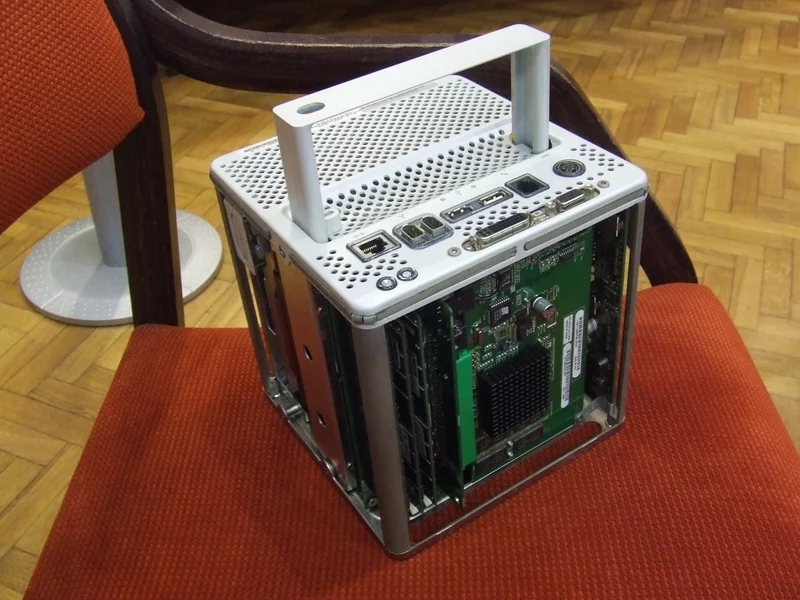
Stunning 8-inch cube design — a design marvel but a commercial failure. Fanless and whisper-quiet.
An eight-inch cube of clear acrylic with the logic board suspended inside it, cooled entirely by convection with no fan at all. The Museum of Modern Art has one. Jobs showed it in July 2000. Inside was a 450 or 500MHz PowerPC 7400, roughly the same performance as the tower, in something a quarter the size and completely silent. The price is why it failed. $1,799 with no display, keyboard or mouse, against Pentium III machines that cost less and expanded further, and the Cube had no internal slots at all. You were paying for the object. Reviewers loved the design, loved the silence, and asked who it was for. Buyers gave the same answer by not buying it. Then the cracks appeared. Hairline marks near the corners, an artifact of the injection molding, cosmetic rather than structural, and thoroughly documented on the internet within weeks. Apple never really resolved the story. It lasted a year. The thermal and design ambitions in it turned up later in the Mac mini and the cylindrical Mac Pro, both of which worked better commercially.
Mac History Timeline
Full Specifications
Availability
Processor
Memory
Storage
Display
Graphics
Expansion
Connectivity
Physical
Processor Deep Dive
PowerPC 7400 (G4)
MotorolaThe Cube used the same PowerPC 7400 found in contemporary Power Mac towers, clocked at 450 or 500MHz, complete with the AltiVec Velocity Engine for accelerated media processing. Its low thermal output made fanless convection cooling feasible inside the tiny cube enclosure, a notable engineering feat for the era. Compared to Pentium III chips of 2000, it offered comparable general performance with an edge in vectorized multimedia tasks, though it lacked any headroom for future upgrades since the Cube had no expansion slots. The chip's modest power draw foreshadowed Apple's later obsession with efficient, quiet desktop computing.
Compatible Operating Systems

Mac OS 9.0.4
Launch OS2000
Shipped as the factory operating system on the original G4 Cube.
Mac OS 9.2.2
Compatible2001
Final and most stable Classic Mac OS release supported on the Cube.

Mac OS X 10.1
Compatible2001
Brought usable OS X performance to the Cube's 450/500MHz G4 processor.
Mac OS X 10.3 Panther
Compatible2003
Ran adequately with RAM maxed out, though the Cube's slower bus limited responsiveness.

Mac OS X 10.4 Tiger
Max Supported2005
Practical ceiling for the Cube since its sub-867MHz clock speed falls below Leopard's minimum requirement.
Reviews & Reception
Nearly universal design acclaim collided with real-world concerns about price, expandability, and cosmetic cracking, making the Cube a beloved but commercially unsuccessful machine.
It is simply the most beautiful computer ever built, a piece of desk sculpture that happens to run Mac OS. Whether it is worth the price compared to a Power Mac tower is another question entirely.
Jobs has built the computing equivalent of a concept car. Gorgeous, silent, and thoroughly impractical for anyone who needs expansion slots.
Reports of hairline cracks in the case have tarnished what should have been an unqualified design triumph.
The Cube's discontinuation after barely a year says everything about the gap between admiring a design and actually buying it.