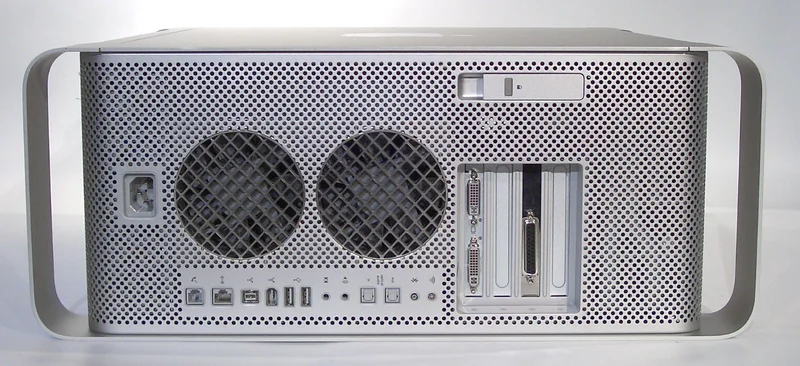
Power Mac G5
First 64-bit personal computer. Spectacular aluminum tower design. Liquid-cooled Dual 2.5 GHz model.
Jobs called it the world's fastest personal computer at WWDC in June 2003, which got the scrutiny it deserved, and underneath the argument sat a genuine architectural jump. Apple left Motorola and went to IBM. The PowerPC 970 came out of the POWER4 server line, and it made the Power Mac G5 the first personal computer sold with a 64-bit processor, about a year before Intel and AMD brought 64-bit to mainstream desktops. The case changed too. Perforated aluminum with grilles front and back, which looked severe and industrial next to the G4 towers and existed because the 970 ran considerably hotter than anything before it. Clocks went from 1.6 to 2.0GHz at launch. A dual 2.5GHz configuration arrived later that needed liquid cooling to stay stable, which is a remarkable thing to ship in a consumer product and caused exactly the reliability problems you would predict once the pumps started failing. Apple's benchmarks against the fastest Pentium 4 machines drew pushback over methodology. The aluminum tower then defined Apple's professional desktop for nearly a decade. The heat did something else, because the G5 never fitted in a laptop, and that is a large part of why Apple announced the move to Intel in 2005.
Mac History Timeline
Full Specifications
Availability
Processor
Memory
Storage
Display
Graphics
Expansion
Connectivity
Physical
Processor Deep Dive
PowerPC 970/970FX/970MP (G5)
IBMThe PowerPC 970, derived from IBM's POWER4 server processor, made the Power Mac G5 the first personal computer to ship with a 64-bit CPU, enabling access to far larger memory addressing and stronger floating-point performance than the outgoing G4 architecture. The 970FX refined the design on a smaller process node for better efficiency, while the 970MP enabled true dual-core configurations in later Power Mac revisions. Compared to contemporary Pentium 4 and Athlon 64 chips, the G5 offered class-leading floating-point throughput but ran notably hot, especially in the flagship dual 2.5GHz configuration, necessitating novel liquid cooling. Its legacy includes proving 64-bit desktop computing was commercially viable, though its thermal demands ultimately outpaced what a laptop-friendly roadmap could sustain.
Compatible Operating Systems

Mac OS X 10.2.7 Jaguar
Launch OS2003
Shipped as the initial factory OS on the first Power Mac G5 models.

Mac OS X 10.3 Panther
Compatible2003
Added full native 64-bit optimizations to take advantage of the PowerPC 970 architecture.

Mac OS X 10.4 Tiger
Compatible2005
Introduced 64-bit command-line application support that specifically benefited G5 owners.
Mac OS X 10.5 Leopard
Max Supported2007
Final PowerPC-compatible OS X release, running well on all Power Mac G5 configurations.
Reviews & Reception
Widely celebrated as a genuine 64-bit architectural breakthrough and striking redesign, tempered by real concerns over heat and noise in the flagship liquid-cooled configuration.
A genuine architectural leap. The move to 64-bit computing, combined with a gorgeous new aluminum case, makes this the most exciting Power Mac in years.
Apple's benchmark claims against Pentium 4 systems deserve scrutiny, but the underlying 970 architecture is legitimately impressive.
The liquid-cooled dual 2.5GHz model is a marvel of engineering ambition, though early reports of pump noise and heat raise real questions about long-term reliability.
A landmark machine for the Mac platform, if a noisier and hotter one than Apple's polished marketing suggested.