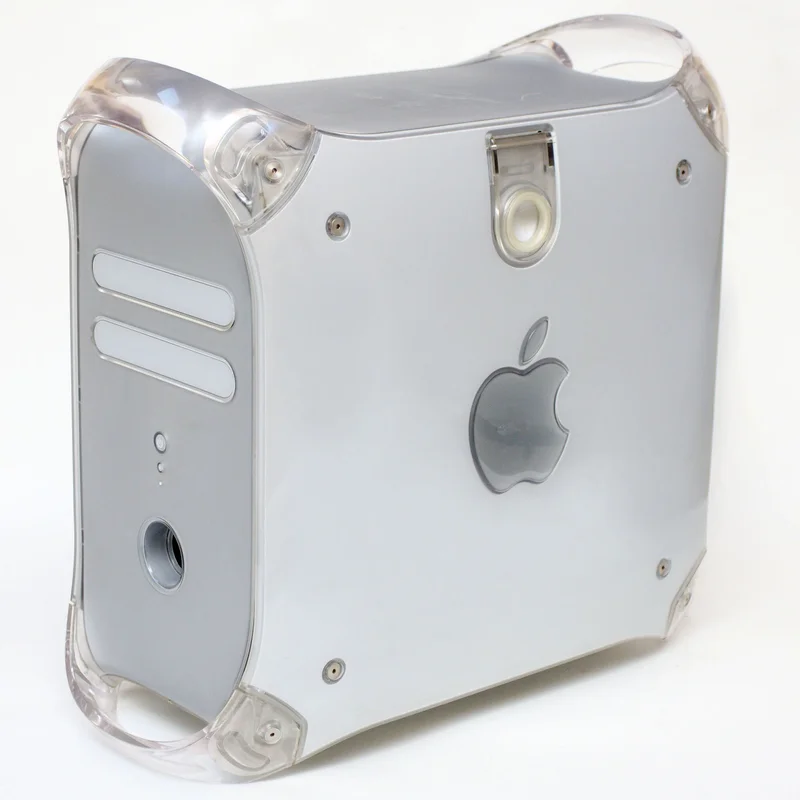
Power Mac G4 (Quicksilver)
Beautiful Quicksilver brushed-aluminum design. First Power Mac to hit 1 GHz.
The Quicksilver is the Power Mac that broke 1GHz, which Apple had been waiting to say for a while. The case went from graphite and translucent plastic to brushed silvery-white polycarbonate, keeping the same chassis and the same swing-out door, and it looked considerably more grown-up and less like a toy. Reviewers said so. The PowerPC 7450 ran from 733MHz to a full gigahertz. Intel and AMD were already past 1.5 and heading for 2, so Apple spent the year arguing that megahertz was a myth and that AltiVec did more per clock on the video and audio work people actually did. The argument was fair, and it was also clearly a defensive position. Final Cut Pro, iMovie and the new iTunes were the evidence, and a SuperDrive option let buyers author DVDs at home, which was still unusual on any personal computer in 2001. It shipped with Mac OS X 10.0.4 while adoption was still ramping. Faster memory bandwidth and a quicker system bus made it tangibly better than the AGP Graphics machines, and it is the last relaxed moment for the G4 tower before Apple needed the G5 rather badly.
Mac History Timeline
Full Specifications
Availability
Processor
Memory
Storage
Display
Graphics
Expansion
Connectivity
Physical
Processor Deep Dive
PowerPC 7450 (G4)
MotorolaThe 7450, part of Motorola's 'Voyager' G4 family, refined the AltiVec Velocity Engine with a deeper pipeline and improved cache architecture, allowing clock speeds to finally reach and exceed 1GHz. It offered meaningfully better performance per clock than the earlier 7400 thanks to a redesigned core and larger L2 cache options. Compared to contemporary Pentium 4 and Athlon XP chips clocked well above 1.5GHz, the 7450 conceded raw clock speed but Apple argued its vector processing closed much of the real-world gap in creative applications. It represented the high-water mark of Motorola's classic G4 desktop design before further scaling challenges emerged.
Compatible Operating Systems
Mac OS X 10.0.4
Launch OS2001
Shipped as the initial factory OS on the Quicksilver Power Mac G4.
Mac OS X 10.1
Compatible2001
Rapidly adopted update that significantly improved OS X responsiveness on this hardware.
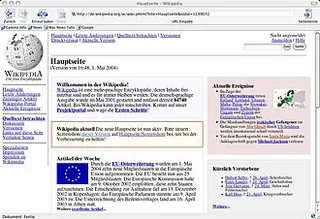
Mac OS X 10.3 Panther
Compatible2003
Ran smoothly given the Quicksilver's gigahertz-class processor and expandable RAM.

Mac OS X 10.4 Tiger
Compatible2005
Fully supported thanks to clock speeds well above the 867MHz Leopard threshold.
Mac OS X 10.5 Leopard
Max Supported2007
Final PowerPC-compatible OS X release, fully usable on the 733MHz-1GHz Quicksilver models.
Reviews & Reception
Well reviewed for its refined design and gigahertz milestone, though clock-speed skepticism against PC rivals persisted.
The new brushed-silver case looks far more grown-up than its predecessor, and cracking the gigahertz barrier is a genuine milestone for the Mac platform.
A handsome, capable workhorse that finally lets Apple claim gigahertz bragging rights, even if Intel and AMD remain well ahead on paper.
Real-world video encoding tests show the Velocity Engine narrowing the gap with faster-clocked PCs, though the megahertz myth argument is wearing thin.
A solid, attractive upgrade for creative professionals already invested in the Mac ecosystem.