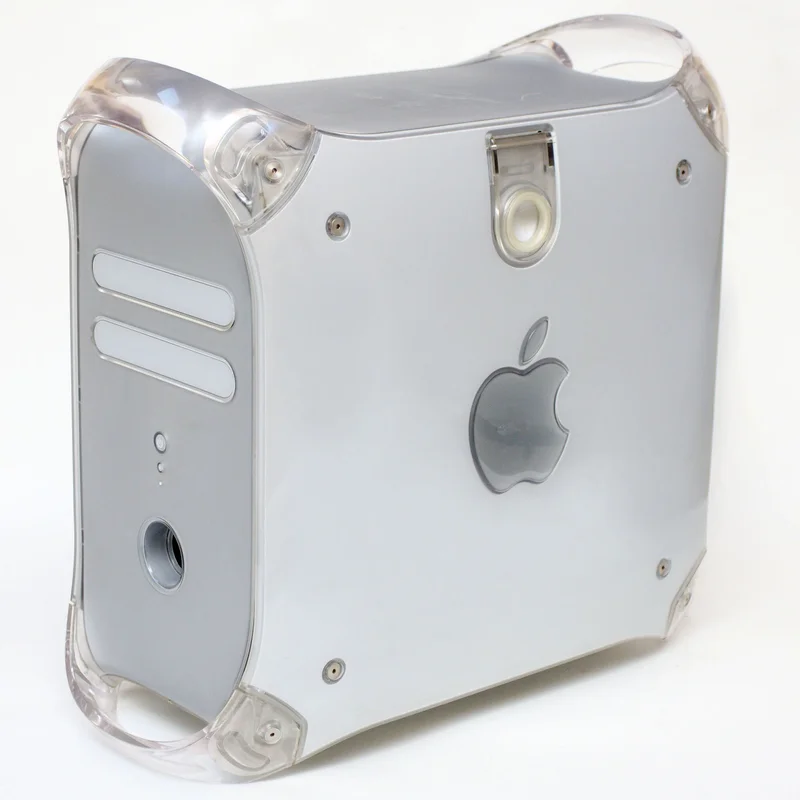
Power Mac G4 (Mirrored Drive Doors)
MDD G4 with dual processors option. Notoriously loud fans but screaming fast. Last G4 tower.
The MDD is the fastest G4 tower Apple built and the loudest computer it has ever sold. The name comes from the front panel, where mirrored symmetrical bays took two optical drives or extra storage, which power users had wanted for years. A PowerPC 7455 ran from 867MHz to 1.42GHz, and for the first time a shipping Power Mac offered two of them. Final Cut Pro and Photoshop could use both, which put the machine against dual-Xeon and Athlon MP workstations on rendering and encoding, even though single-threaded work still went to the fastest Pentium 4s. Two G4s run hot. Apple's answer was fans, a lot of them, turning quickly, and the machine earned the nickname wind tunnel almost immediately. In a quiet studio it was genuinely disruptive, and owners still bring it up twenty years on. It shipped with Jaguar in August 2002 and it is the last G4 desktop Apple made, because the G5 arrived the following year on IBM silicon and ended the line. Collectors want them and then discover why they were cheap.
Mac History Timeline
Full Specifications
Availability
Processor
Memory
Storage
Display
Graphics
Expansion
Connectivity
Physical
Processor Deep Dive
PowerPC 7455 (G4)
MotorolaThe 7455 powered the Mirrored Drive Doors Power Mac at clock speeds from 867MHz up to 1.42GHz, available in both single and, for the first time in a Power Mac, dual-processor configurations. It retained the AltiVec Velocity Engine, giving strong performance in optimized creative applications, and the dual-CPU option offered genuine multi-threaded gains for professional rendering and encoding work. Compared to contemporary Pentium 4 and Athlon MP workstation chips, the 7455 conceded single-core clock speed but competed credibly in AltiVec-accelerated tasks when running two processors in tandem. Higher clock speeds pushed thermal output up considerably, necessitating the aggressive cooling that gave the MDD its notorious noise reputation.
Compatible Operating Systems
Mac OS X 10.2
Launch OS2002
Shipped as the factory OS on the original Mirrored Drive Doors Power Mac G4.
Mac OS X 10.3 Panther
Compatible2003
Added improved dual-processor support that benefited the MDD's dual-CPU configurations.

Mac OS X 10.4 Tiger
Compatible2005
Ran well given the MDD's clock speeds comfortably above the Leopard hardware threshold.
Mac OS X 10.5 Leopard
Max Supported2007
Fully supported across all MDD configurations since even the base model exceeds the 867MHz minimum.
Reviews & Reception
Respected for genuine dual-processor performance gains but widely criticized for excessive, disruptive fan noise that overshadowed its technical merits.
The dual-processor option is a genuine boon for video professionals, though be warned: this is the loudest Power Mac Apple has ever shipped.
Fan noise aside, the dual 1GHz configuration delivers real, measurable gains in rendering and encoding benchmarks.
Apple engineers seem to have prioritized cooling over sanity. This machine sounds like a small aircraft taking off.
A capable, if unpleasant-sounding, workhorse that closes out the G4 tower era on a technically strong note.