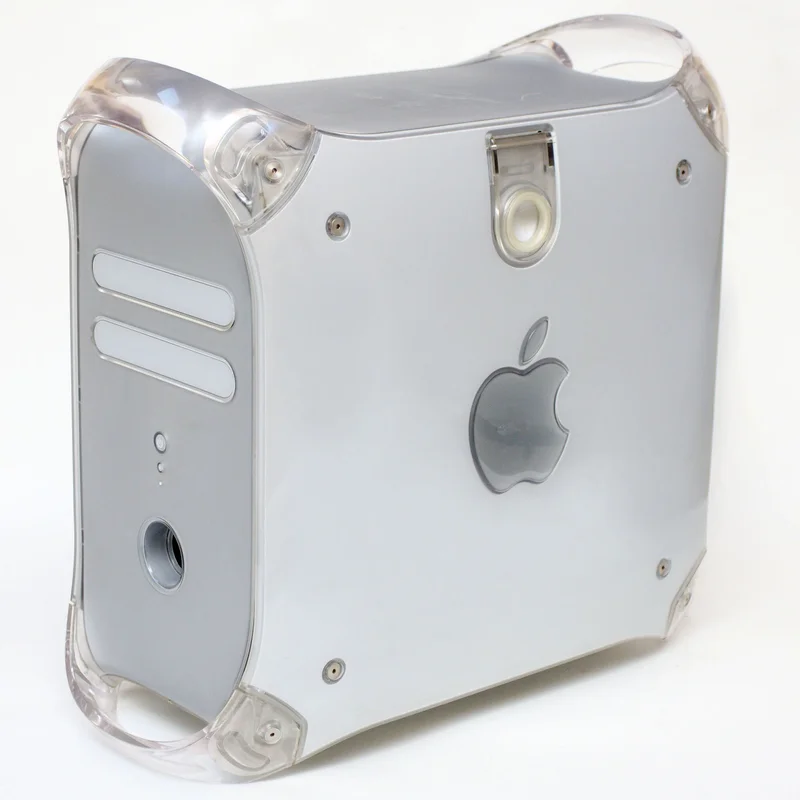
Power Mac G4 (AGP Graphics)
First Mac with an AGP graphics slot. The G4 chip's Velocity Engine made Apple brag about TFLOP performance.
Jobs introduced the AGP Graphics G4 at Seybold in August 1999, and its headline claim got Apple into a legal argument. Motorola's PowerPC 7400 carried a vector unit called AltiVec, which Apple branded the Velocity Engine, and which pushed the machine past the threshold the United States used to define a supercomputer for export control. Apple ran advertisements about needing an export license. It sued Intel over the word. Skeptics pointed out that the figure depended on hand-tuned AltiVec code rather than anything you would run on a Tuesday, and they were right, though the vector unit did genuinely transform video encoding and Photoshop filters. The AGP slot was the substantive change, since ATI Rage 128 Pro and later GeForce2 MX cards made 3D and gaming dramatically better than the PCI-bound G3 could manage. Then Motorola could not produce enough 500MHz chips. Apple shipped 450MHz processors in boxes marked 500 and ended up issuing refunds, which is a rare and genuinely embarrassing lapse. Clocks ran 350 to 500MHz against Pentium III and early Pentium 4 machines that usually won on megahertz. It shipped with Mac OS 9 while OS X was still in beta, and Final Cut Pro had just arrived, which tells you who bought it.
Mac History Timeline
Full Specifications
Availability
Processor
Memory
Storage
Display
Graphics
Expansion
Connectivity
Physical
Processor Deep Dive
PowerPC 7400/7450 (G4)
MotorolaThe PowerPC 7400 introduced the AltiVec vector processing unit, branded by Apple as the Velocity Engine, enabling dramatic speedups in media encoding, graphics filters, and scientific computation compared to the preceding G3. Clocked between 350 and 500MHz in this generation, it traded raw clock speed against contemporary Pentium III/4 chips for superior throughput in vectorized workloads. The 7400 was fabricated on a 0.25/0.18-micron process and became the first PowerPC to be marketed under export-control supercomputer rules due to its theoretical FLOPS output. It laid the architectural foundation Motorola and later Freescale would refine through the 7450 'Voyager' and subsequent G4 variants.
Compatible Operating Systems
Mac OS 9.0
Launch OS1999
Shipped as the original operating system on the AGP Graphics Power Mac G4.
Mac OS 9.1
Compatible2001
Improved stability and was the recommended Classic environment base once OS X arrived.

Mac OS X 10.1
Compatible2001
First OS X release with acceptable performance and Classic compatibility on these G4 towers.
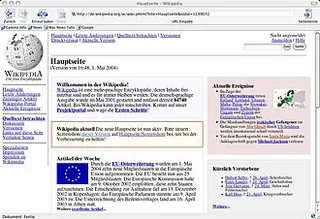
Mac OS X 10.3 Panther
Compatible2003
Ran well on the faster 450/500MHz AGP models with sufficient RAM upgrades.

Mac OS X 10.4 Tiger
Max Supported2005
Practical performance ceiling for the earliest 350MHz AGP Graphics units.
Reviews & Reception
Generally well received for its AGP graphics and AltiVec performance, tempered by clock-speed shortage controversy and skepticism over Apple's supercomputer marketing.
The AGP slot alone justifies the upgrade for anyone doing serious 3D or video work; the Velocity Engine claims may be marketing hyperbole, but real-world gains in Photoshop are undeniable.
Apple's supercomputer rhetoric is a bit much, but this is unmistakably the most capable Mac tower yet built.
The 500MHz shortage debacle undercuts what is otherwise an admirable leap forward in Apple's desktop architecture.
A strong performer for creative professionals, though PC rivals still edge it out on pure clock speed benchmarks.