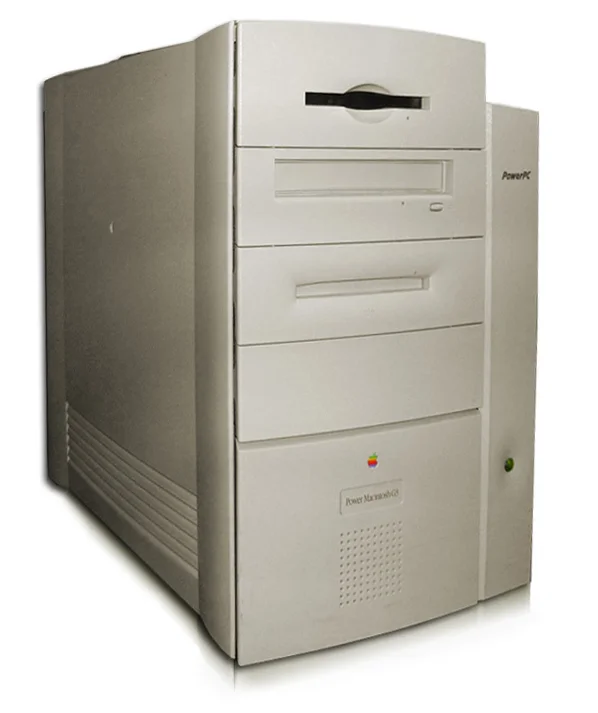
Power Macintosh G3 (Beige)
First G3 desktop. Dramatically outperformed competing Pentium IIs at a lower price, reviving Apple's fortunes.
In November 1997 Apple shipped the fastest desktop computer you could buy, which nobody expected from a company most of the press had written off. The PowerPC 750, marketed as the G3, ran from 233 to 333MHz across the machine's life. Its short pipeline and large on-chip cache meant it did more work per clock than a Pentium II, so Apple could show a 266MHz Mac beating a 300MHz Pentium II on real productivity and content work. The tech press checked and the numbers held. That had not happened in years. Jobs had returned earlier that year and the marketing department was newly awake, so the comparison went into every advertisement. The case was a beige minitower much like the 7300's, with an all-in-one variant alongside it, and underneath sat ADB, a floppy drive and Old World ROM. That last detail matters, because the Beige G3 is the final Old World ROM desktop and cannot officially run Mac OS X, unlike the New World machines that followed months later. What it actually did was restore confidence. Apple was still losing money and losing share, and being able to say fastest, accurately, gave the company something to build 1998 on.
Mac History Timeline
Full Specifications
Availability
Processor
Memory
Storage
Display
Graphics
Expansion
Connectivity
Physical
Processor Deep Dive
PowerPC 750 (G3)
IBM/MotorolaThe PowerPC 750, marketed by Apple as the G3, was a major architectural leap featuring a short, efficient six-stage pipeline and a large on-chip level 2 cache interface that dramatically improved instructions-per-clock performance over the previous 604e generation. Running at 233 to 333MHz in the Beige G3, it famously outperformed Intel's Pentium II in numerous real-world and synthetic benchmarks despite comparable or lower clock speeds, becoming one of Apple's most celebrated performance stories of the 1990s. Its efficiency and cache design established the architectural foundation that would carry Apple's desktop and portable lines for the next several years.
Compatible Operating Systems
Mac OS 8.0
Launch OS1997
Shipped with the Beige G3 at its November 1997 introduction.
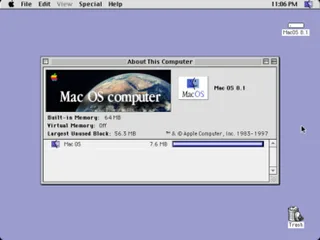
Mac OS 8.1
Compatible1997
Added HFS+ support and improved USB-era foundations.
Mac OS 8.6
Compatible1999
Popular late-life upgrade offering improved stability and networking.

Mac OS 9.1
Max Supported2000
The generally recommended practical maximum given the Old World ROM's boot limitations.
Mac OS 9.2.2
Compatible2001
Could run with reduced reliability, though officially Apple never fully certified it here.
Reviews & Reception
The Beige G3 earned enthusiastic reviews for its startling real-world speed advantage over Intel's Pentium II, widely seen as a turning point for Apple's credibility.
The G3 doesn't just compete with Pentium II, it beats it, often by a wide margin, and that changes the entire conversation about what a Mac can do.
Our benchmarks confirm what Apple has been claiming: clock for clock and often beyond, the G3 outpaces Intel's newest flagship chip.
We're accustomed to writing off Apple's performance claims, but the G3 forces a reassessment; this is a legitimately fast machine by any standard.
For a company many had counted out, the Beige G3 is a remarkable statement of engineering strength, even if the aging case design feels overdue for a refresh.