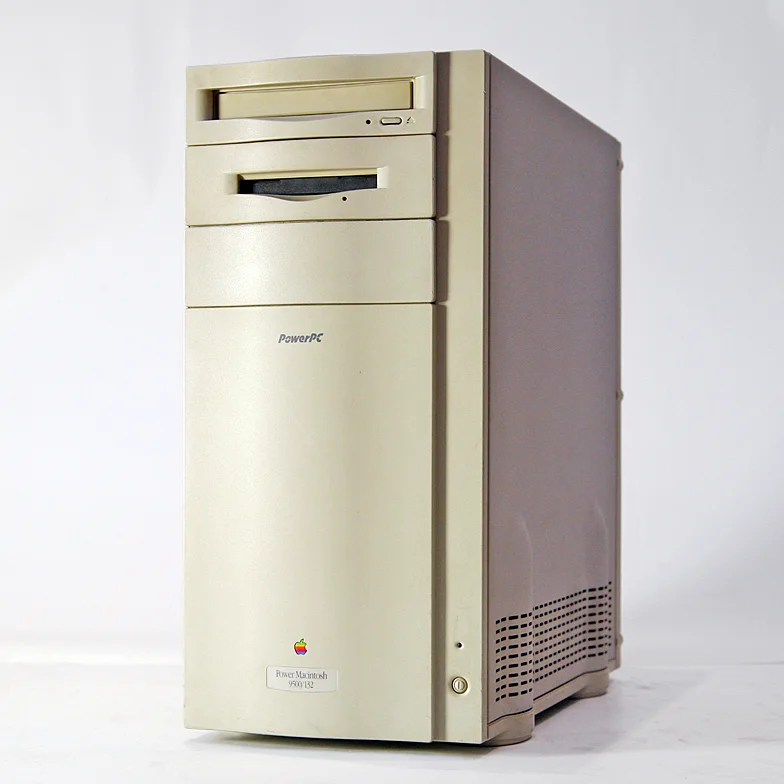
Power Macintosh 9500
Professional workstation powerhouse with 12 DIMM slots and 6 PCI slots. Beloved by video professionals.
The 9500 arrived June 19, 1995 as Apple's first Power Mac built around PCI instead of NuBus, which put the Mac on the same expansion standard as the rest of the industry. A PowerPC 604 at 120 or 132MHz, later 150, in a minitower with six full-length PCI slots and twelve DIMM sockets holding up to 1.5GB of RAM. In 1995 that ceiling was absurd, and it was exactly what video and print people wanted. They bought it immediately. Digitizing cards, RAID controllers and multi-monitor rigs all needed slots, and this was the first Mac with enough of them to build the configurations professionals had been describing for years. System 7.5.1 ran noticeably better than it had on the NuBus machines, and throughput held up against Pentium and Pentium Pro workstations of the same year. Not everything went well. A batch of early logic boards had a badly designed clock-doubling circuit and Apple ran a recall and replacement program, which was embarrassing on a flagship. Avid and Media 100 editors kept them for years regardless. The 9500 set the shape of Apple's professional tower through the 7300, the beige G3 and eventually the Blue and White G3.
Mac History Timeline
Full Specifications
Availability
Processor
Memory
Storage
Display
Graphics
Expansion
Connectivity
Physical
Processor Deep Dive
PowerPC 604
Motorola/IBMThe PowerPC 604 was a superscalar, out-of-order execution RISC processor jointly developed by the AIM alliance (Apple, IBM, Motorola) as a high-performance successor to the 601. It could issue up to four instructions per cycle across six execution units, giving it a substantial lead over the 601 in integer and floating-point workloads. At launch it traded blows with Intel's Pentium at similar clock speeds despite running at lower megahertz figures, reinforcing the RISC-versus-CISC performance debate of the mid-1990s. It powered Apple's high-end and mid-range Power Macs through the mid-1990s before giving way to the 604e and eventually the G3.
Compatible Operating Systems

System 7.5.1
Launch OS1995
Shipped standard on the Power Macintosh 9500.
Mac OS 7.5.3
Compatible1996
Improved PCI Power Mac stability and networking.
Mac OS 7.6
Compatible1997
First release officially branded 'Mac OS' rather than 'System'.
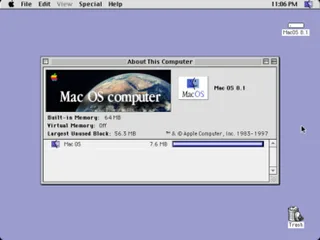
Mac OS 8.1
Max Supported1997
Widely considered the practical performance ceiling for 604-based Power Macs.
Mac OS 8.6
Compatible1999
Ran with unofficial patches but was never officially supported on 604 hardware.
Reviews & Reception
The Power Macintosh 9500 was widely praised as Apple's most expandable and capable professional machine to date, despite an early hardware recall.
The 9500 is the Power Mac professionals have been waiting for: six PCI slots and room for over a gigabyte of RAM make it a true workstation, not just a fast beige box.
Video editors will find their new home here. The 604 processor combined with PCI expansion finally gives Apple a machine that can swallow whatever capture card you throw at it.
In our benchmark suite the 9500 traded blows with comparably clocked Pentium systems, a striking result for a RISC chip running at ostensibly lower megahertz.
Performance is excellent, but the early recall over a defective clock circuit reminds buyers that even Apple's flagship isn't immune to first-run growing pains.