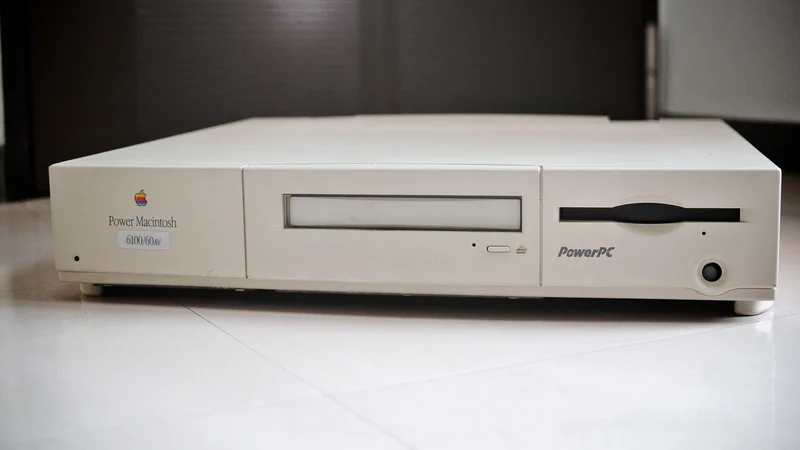
Power Macintosh 7500
Mid-range PCI Power Mac with easily upgradeable daughtercard processor.
The 7500's best feature was a socket. Apple put the processor on a removable daughtercard rather than soldering it to the logic board, so a machine bought in 1995 with a 100MHz PowerPC 601 could later take a 604, and eventually a third-party G3 card. That is why 7500s were still in service years after their original silicon had become embarrassing. A small industry grew up selling upgrade cards for them, and Mac tinkerers treated the machine as a platform rather than a purchase. It shipped August 28, 1995 with three PCI slots, Mac OS 7.5.2, and a low desktop case with a flip-down front door that Apple reused across the 7200, 7300 and the beige G3 minitowers. Against the 9500 it gave up three slots and a lot of money. Against a 1995 Pentium the 601 was already looking slow, which reviewers noted before pointing out that this was the one Mac where that mattered least. Schools and small businesses bought them. So did tinkerers. It never had the 8500's video glamour or the 9500's horsepower, and it outlasted both in daily use.
Mac History Timeline
Full Specifications
Availability
Processor
Memory
Storage
Display
Graphics
Expansion
Connectivity
Physical
Processor Deep Dive
PowerPC 601
IBM/MotorolaThe PowerPC 601 was the first PowerPC processor to ship in Apple hardware, a joint IBM/Motorola design that launched the Power Macintosh line in 1994. It combined a superscalar RISC core with hybrid features borrowed from IBM's POWER architecture, giving it strong integer performance for its era. By 1995, the 601 running at 100MHz in the 7500 was already the entry point of Apple's PowerPC line, being eclipsed by the newer 604, but it remained perfectly capable for everyday productivity and was praised for besting many Pentium systems in emulated and native benchmark comparisons.
Compatible Operating Systems

Mac OS 7.5.2
Launch OS1995
Shipped with the Power Macintosh 7500 at introduction.
Mac OS 7.5.5
Compatible1996
Improved reliability for PCI-based Power Macs.
Mac OS 7.6.1
Compatible1997
Final System 7 family release many 7500 owners settled on.
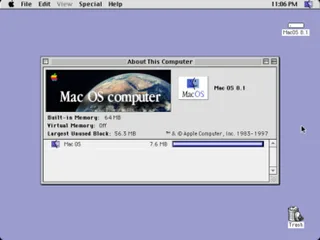
Mac OS 8.1
Max Supported1997
Generally the practical ceiling for 601-based Power Macs, even with later CPU upgrade cards installed.
Reviews & Reception
The 7500 won praise chiefly for its upgradeable CPU daughtercard, seen as a smart hedge for budget-conscious buyers even though its stock 601 processor wasn't class-leading at launch.
The 7500's removable CPU card is its ace in the hole: buy in now at a reasonable price and upgrade the processor later without replacing the whole machine.
It lacks the 9500's six slots, but for most small studios three PCI slots and a flexible upgrade path is more than enough.
Against the fastest Pentium desktops the base 601 configuration looks modest, though Apple's upgrade-card strategy is a clever hedge against obsolescence.
We've rarely seen a mainstream desktop this committed to future-proofing its own processor; the 7500 rewards patient owners.