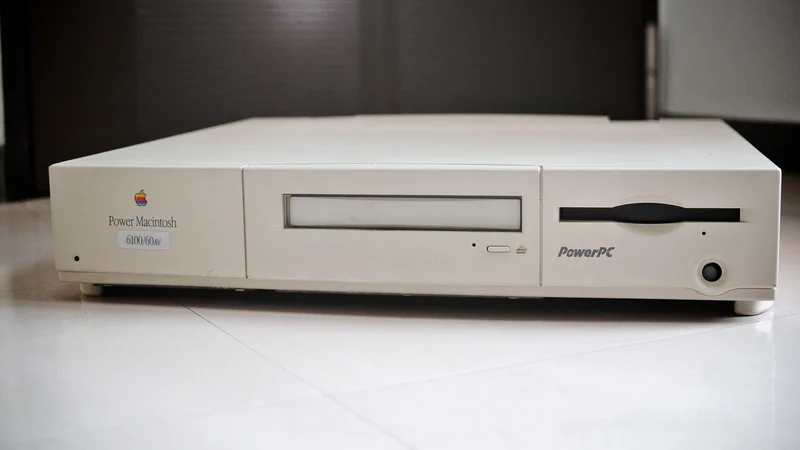
Power Macintosh 7200
Entry-level PCI Power Mac replacing the NuBus models. Good value for the money.
The 7200 was the cheap way into PCI. February 5, 1996, a PowerPC 601 between 75 and 120MHz, three PCI slots, Mac OS 7.5.3, and a compact desktop case. Apple needed it. The NuBus 6100, 7100 and 8100 were aging badly, and schools and small offices wanted the modern expansion architecture without 7500 or 9500 money. The savings show where you would expect. The processor is socketed rather than sitting on the 7500's swappable daughtercard, so there is no upgrade path, memory configuration is less flexible, and the audio is worse than its siblings. Reviewers called it sensible and dull, which it was. No AV hardware, no six slots, adequate speed for word processing and spreadsheets, and a price well under the rest of the line. Against Windows 95 machines in early 1996 the 601 was falling behind as Pentium clocks climbed, and the PCI slots were most of the counterargument. Computer labs bought a great many. Apple needed volume at that moment, with the clone market biting and the finances deteriorating, and the 7200 kept classrooms and small businesses on the platform until the G3 arrived.
Mac History Timeline
Full Specifications
Availability
Processor
Memory
Storage
Display
Graphics
Expansion
Connectivity
Physical
Processor Deep Dive
PowerPC 601
IBM/MotorolaThe PowerPC 601 was the original PowerPC chip that launched Apple's RISC transition in 1994, combining superscalar execution with roots in IBM's POWER architecture. By the time it appeared in the budget-tier 7200 at speeds from 75 to 120MHz, it was Apple's most affordable PowerPC option, offering solid integer performance for everyday productivity tasks. It held up reasonably against entry-level Pentium systems of the mid-1990s, though it was clearly being phased out in favor of the newer 604 and 604e chips used in Apple's higher-end machines.
Compatible Operating Systems

Mac OS 7.5.3
Launch OS1996
Shipped with the Power Macintosh 7200 at its February 1996 launch.
Mac OS 7.5.5
Compatible1996
Stability update widely installed on entry-level Power Macs.
Mac OS 7.6.1
Compatible1997
Popular late System 7 release for budget PCI Power Macs.
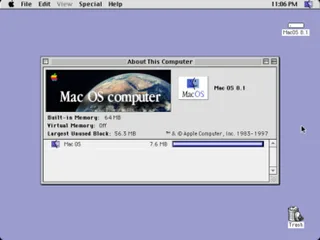
Mac OS 8.1
Max Supported1997
Practical performance ceiling given the 601 processor's limitations.
Reviews & Reception
The 7200 was received as a sensible if unexciting entry point into PCI-based Power Mac computing, valued for its price but seen as lagging in raw performance.
The 7200 brings PCI expansion within reach of budget buyers, even if it lacks the flexibility of its pricier 7500 sibling.
It's a capable everyday Mac for schools and small offices, though the 601 processor is starting to show its age against newer 604-based machines.
Entry-level Power Macs like the 7200 are reasonably priced, but Pentium PCs at similar price points are pulling ahead in raw clock speed.
For basic productivity, the 7200 is a dependable, no-frills choice that finally brings PCI slots to Apple's most affordable desktop tier.