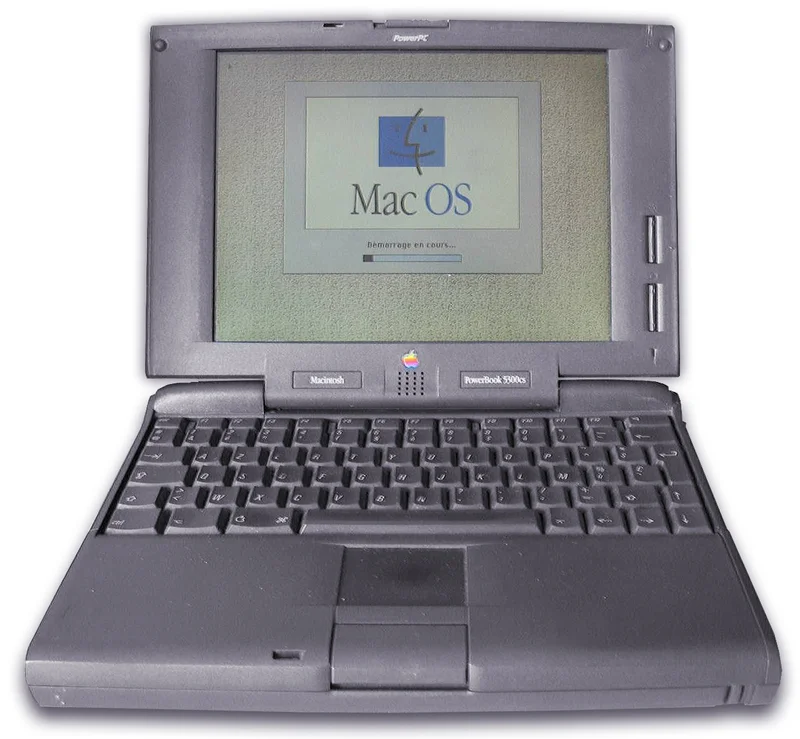
PowerBook 5300
First PowerPC PowerBook. Plagued by battery recall but notable as the transition to RISC laptops.
The 5300 was Apple's first PowerPC laptop and one of its worst products. The idea was sound. A PowerPC 603e at 100 or 117MHz brought RISC performance to a portable, the case was lighter than the 500 series it replaced, and an active-matrix color screen was available. Then a battery caught fire during pre-release testing. Apple had moved to lithium ion for the better energy density, the chemistry was not ready, and the company delayed the top 5300c models and then recalled and replaced batteries across the line. The case cracked too, particularly around the hinges, and the swappable expansion bay that took a floppy, a CD-ROM or a second battery brought its own faults. Reviewers were blunt. Toshiba and IBM were shipping dependable Pentium laptops that year without setting themselves alight. The 603e itself was a good low-power chip and deserved better. Apple learned expensive lessons about new battery chemistry and new case materials, applied them to the 1400 and the 3400c, and spent years referring back to this machine internally. It belongs to the stretch of 1995 and 1996 that eventually brought Steve Jobs back.
Mac History Timeline
Full Specifications
Availability
Processor
Memory
Storage
Display
Graphics
Expansion
Connectivity
Physical
Processor Deep Dive
PowerPC 603e
IBM/MotorolaThe PowerPC 603e was a low-power derivative of the original 603 core, designed specifically with battery-powered portable computing in mind, featuring a larger on-chip cache and improved efficiency over its predecessor. Running at 100 or 117MHz in the PowerBook 5300, it delivered solid performance per watt for its era, an important consideration given the limited battery technology available in 1995. It compared reasonably well to contemporary mobile Pentium chips in efficiency, even if raw clock speeds lagged, and its architecture would go on to power several subsequent PowerBook generations.
Compatible Operating Systems

Mac OS 7.5.2
Launch OS1995
Shipped standard on the PowerBook 5300 at introduction.
Mac OS 7.5.3
Compatible1996
Addressed early PowerBook 5300 stability and power-management bugs.
Mac OS 7.6.1
Compatible1997
Widely adopted stable release for 603e-based PowerBooks.
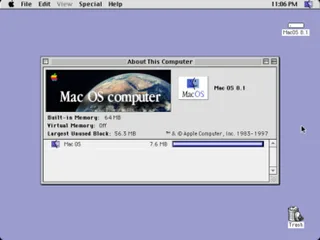
Mac OS 8.1
Max Supported1997
Generally regarded as the practical ceiling for reliable day-to-day use.
Mac OS 8.6
Compatible1999
Could run with reduced functionality via unofficial patches, though never officially supported.
Reviews & Reception
The PowerBook 5300 was met with disappointment and concern, its promising PowerPC debut overshadowed by a battery recall and case durability problems.
The 5300 brings PowerPC performance to the road, but reports of case cracking and the battery delay cast a shadow over what should have been a triumphant launch.
We can't recommend the 5300c until Apple resolves the battery safety concerns that delayed its release in the first place.
Underneath the controversy is a genuinely capable low-power RISC processor; it's a shame the execution around it was so troubled.
Apple's first PowerPC laptop should have been a landmark; instead it's become synonymous with recalls and hinge failures.