PowerBook 520c
Introduced the 'Blackbird' slim design with trackpad instead of trackball. Active-matrix color display.
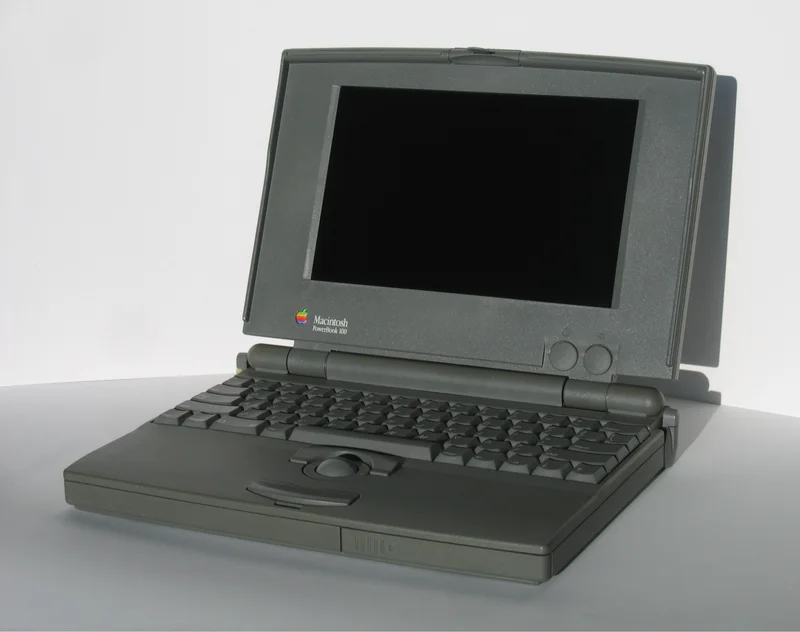
The 520c introduced the Blackbird case. It also introduced the trackpad. Every PowerBook since 1991 had a trackball in the middle of the palm rest. The 520c replaced it with a flat pressure-sensitive pad, and although longtime owners complained at first, the trackpad was more precise, took less depth, and had no ball to collect grime. Every laptop maker followed, Windows ones included. The rest of the case was new too. Rounder, more comfortable, with a speaker above the keyboard and an internal layout that managed heat better and left room for faster processors later. Inside was a 68LC040 at 25MHz, a cheaper 68040 with the floating-point unit removed, behind an active-matrix color screen, which against the 68030-based 165c and 180c felt considerably quicker in ordinary use. Anyone doing serious numeric work noticed the missing FPU, and reviewers said so. Battery life was the usual problem for a color active-matrix machine. The design mattered more than the specification, since the Blackbird chassis and its trackpad led directly to the 540c and the 5300, and it is roughly what a Mac laptop has looked like ever since.
Mac History Timeline
Full Specifications
Availability
Processor
Memory
Storage
Display
Graphics
Expansion
Connectivity
Physical
Processor Deep Dive
Motorola 68LC040
MotorolaThe 68LC040 was a cost-reduced variant of the 68040 that omitted the integrated floating-point unit to lower manufacturing cost and power draw, making it well suited to battery-powered portables like the 520c. Running at 25MHz, it retained the 68040's improved cache architecture and instruction pipeline, delivering solid everyday performance even without hardware FPU support. This tradeoff made sense for a mainstream color PowerBook where general responsiveness mattered more than floating-point-heavy scientific or graphics workloads. It represented Apple's pragmatic approach to bringing 68040-class performance to a wider portable audience.
Compatible Operating Systems

System 7.1
Launch OS1994
Shipped from the factory as the PowerBook 520c's original operating system.
System 7.5
Compatible1994
Ran well, taking advantage of the 520c's improved trackpad-based Blackbird design and color display.
System 7.5.5
Max Supported1996
Considered the practical performance ceiling for this 68LC040-based PowerBook.
Mac OS 7.6.1
Compatible1997
Installable with adequate RAM but offered limited benefit given the aging 68k architecture.
Reviews & Reception
The PowerBook 520c was praised for its influential Blackbird redesign and trackpad innovation, setting a new ergonomic standard for Mac laptops.
The switch to a trackpad is an immediate improvement, and the new Blackbird design finally modernizes the PowerBook's aging silhouette.
Some trackball loyalists will need an adjustment period, but the 520c's trackpad is simply more precise and more comfortable.
Lacking a floating-point unit, the 68LC040 shows its limits in computation-heavy tasks, though everyday responsiveness remains strong.
Apple's new industrial design sets a fresh standard for laptop ergonomics that competitors will likely study closely.