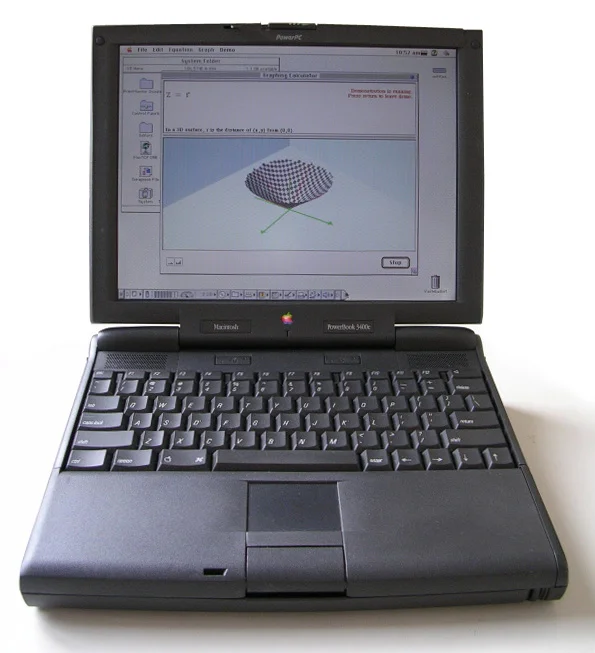
PowerBook 3400c
Briefly the world's fastest laptop. Introduced built-in infrared and multimedia features.
For a few months in 1997 Apple sold the fastest laptop in the world, which the company needed rather badly at the time. The 3400c ran a PowerPC 603ev between 180 and 240MHz under Mac OS 7.6.1 and beat comparably priced Pentium and Pentium MMX portables from Toshiba, IBM and Compaq at launch. Given where the 5300 had left Apple's reputation, that was a considerable recovery. It fixed the 5300 point by point. Sturdier case, batteries that behaved, an active-matrix color screen and a PCI internal architecture, plus a swappable bay taking batteries, floppy drives or CD-ROM modules. It cost a lot. This was among the most expensive laptops on sale, and the angular businesslike styling made clear Apple wanted corporate buyers rather than only the creative professionals who had stayed loyal. The timing mattered more than the machine. Apple in early 1997 was absorbing NeXT and running on interim leadership, and having the fastest laptop on earth was something the marketing department could actually use. The engineering fed directly into the PowerBook G3 Wallstreet a year later.
Mac History Timeline
Full Specifications
Availability
Processor
Memory
Storage
Display
Graphics
Expansion
Connectivity
Physical
Processor Deep Dive
PowerPC 603ev
IBM/MotorolaThe PowerPC 603ev was an enhanced, higher-clocked evolution of the 603e core, optimized for both performance and power efficiency in mobile systems. Running as fast as 240MHz in the 3400c, it briefly made this PowerBook the fastest laptop in the world, outperforming contemporary mobile Pentium chips in several benchmarks. Its efficient design and larger cache helped it balance speed with the battery life demands of portable computing, and it represented a major refinement over the original 603 family used in the earlier PowerBook 5300.
Compatible Operating Systems

Mac OS 7.6.1
Launch OS1997
Shipped with the PowerBook 3400c at its February 1997 launch.
Mac OS 8.0
Compatible1997
Brought the new Platinum interface to the 3400c.
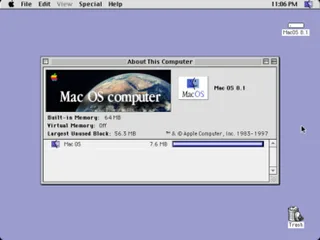
Mac OS 8.1
Compatible1997
Added HFS+ support, widely adopted on the 3400c.
Mac OS 8.6
Max Supported1999
Considered the practical performance and stability ceiling for the 603ev processor.

Mac OS 9.0.4
Compatible1999
Would run but felt sluggish given the machine's aging processor and limited RAM ceiling.
Reviews & Reception
The 3400c was celebrated across the tech press as a redemption story for Apple's portable line, earning genuine praise for briefly outrunning every Windows laptop on the market.
The 3400c isn't just fast for a Mac laptop, it's the fastest laptop on the planet, full stop, and it finally puts the 5300's troubles behind Apple for good.
In our mobile benchmark suite the 3400c outran every Pentium-based notebook we tested, an impressive reversal after Apple's rocky PowerBook history.
Apple's new flagship laptop is genuinely quick and well built, though its price puts it firmly in the realm of committed professionals rather than casual buyers.
The 3400c shows Apple has learned hard lessons from the 5300; the case feels solid and the speed advantage over Windows laptops is real, if temporary.