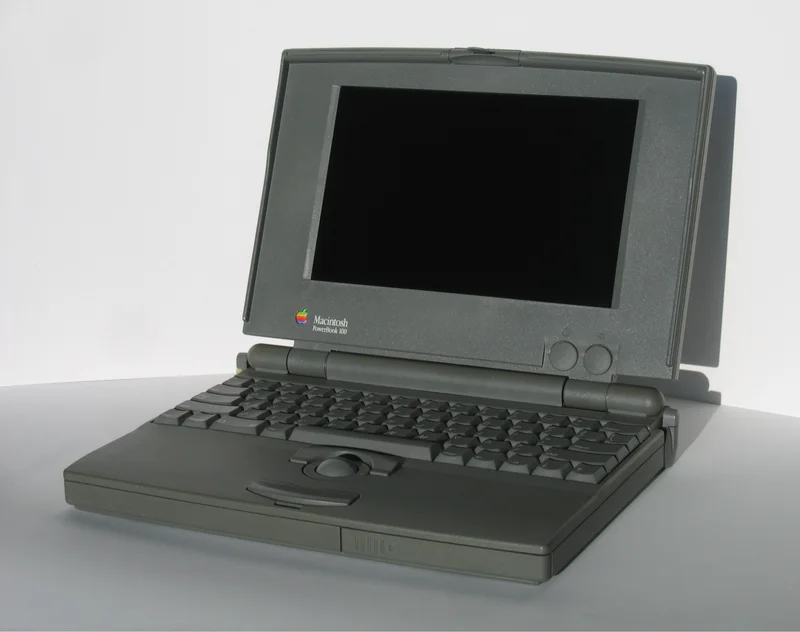
PowerBook 180c
First active-matrix color PowerBook. Excellent screen for the time, praised by professionals.
The 180c arrived June 7, 1993 and fixed the 165c inside the same calendar year, as Apple's first active-matrix color PowerBook. 256 colors, no ghosting, no smearing. Everything the 165c's screen did badly, this one did well. Fast motion stayed sharp, colors came out accurate rather than washed, and the panel responded quickly enough that graphics and design work on the road became a reasonable proposition rather than a demonstration. Underneath it was the 180: a 68030 at 33MHz in the chassis and ergonomics that had already made the monochrome version a favorite. Designers and sales teams bought them, as did anyone who wanted the best portable Mac available and could pay for it, which was a lot. Active-matrix panels were expensive and thirsty. Battery life came in below the monochrome 180's, and Windows laptops were only starting to use active matrix at this point, so the usual comparison went Apple's way. The real limitation was the processor, since 68040 Quadras were already on desktops and the 180c's screen was arguably ahead of the silicon behind it. Apple took the lesson into the Duo 270c and 280c.
Mac History Timeline
Full Specifications
Availability
Processor
Memory
Storage
Display
Graphics
Expansion
Connectivity
Physical
Processor Deep Dive
Motorola 68030
MotorolaThe 180c's 33MHz 68030 was the same capable mid-tier chip used across several PowerBooks of the period, here paired with Apple's first active-matrix color display. Its integrated MMU handled System 7.1's memory management demands comfortably, ensuring the processor itself was never the limiting factor for typical use. Compared to the emerging 68040, it lacked an integrated FPU and cache improvements, but remained efficient and reliable for portable designs. It represented the mature, dependable backbone of Apple's late 68k-era portables.
Compatible Operating Systems

System 7.1
Launch OS1993
Shipped from the factory as the PowerBook 180c's original operating system.
System 7.5
Compatible1994
Ran well, taking full advantage of the 180c's active-matrix screen for a smooth graphical experience.
System 7.5.5
Max Supported1996
Regarded as the sensible performance ceiling for this 68030-based color PowerBook.
Mac OS 7.6.1
Compatible1997
Technically installable but noticeably strained given the 180c's aging processor.
Reviews & Reception
The PowerBook 180c was celebrated as a triumphant, if pricey, realization of Apple's active-matrix color portable ambitions.
The 180c is the color PowerBook we've been waiting for, its active-matrix screen finally delivers on the promise color portables made months ago.
Vivid, fast, and genuinely usable for real design work, the 180c corrects nearly every complaint we had about the 165c.
A stunning display comes at a stunning price, but professionals who need color on the road will find it worth every penny.
Battery life suffers noticeably compared to monochrome PowerBooks, a fair tradeoff for this much visual quality.