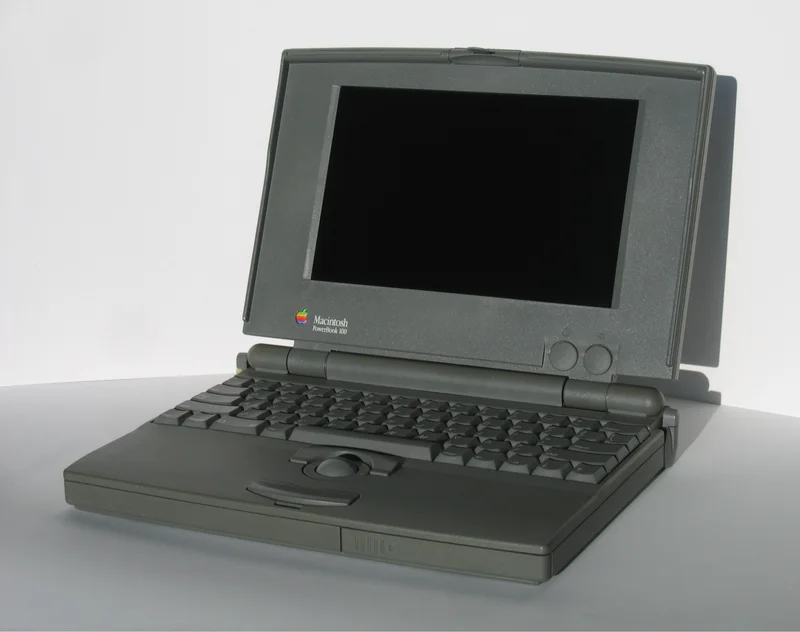
PowerBook 180
Fastest PowerBook of 1992. First to include an active-matrix greyscale display.
The 180 topped the second PowerBook generation on October 19, 1992 with a 68030 at 33MHz and, more importantly, an active-matrix grayscale screen. That panel is the whole reason to care about this machine. Passive-matrix screens like the 160's ghosted and smeared, and dragging a window or scrolling quickly left trails across the display. Active matrix did not. It was the first Mac notebook screen that stayed comfortable through a long working day. The chassis was the PowerBook shape everyone had already copied: recessed keyboard, palm rests, trackball in the middle. A math coprocessor was available, and the 180 took more RAM and storage than the 160, which made it genuinely competitive with desktop Macs for a lot of work. Reviewers wrote about the screen and little else. Against Windows laptops still shipping monochrome STN panels, this was the usual evidence that Apple was ahead on portables. It cost a lot. Battery life came in under the 160's, because a brighter screen and a faster clock both draw more, and the real-world speed gain over the 160 was modest for ordinary office work. The display was what you were paying for. Color arrived with the 165c and 180c the following year, which makes the 180 the last and best of the black-and-white PowerBooks.
Mac History Timeline
Full Specifications
Availability
Processor
Memory
Storage
Display
Graphics
Expansion
Connectivity
Physical
Processor Deep Dive
Motorola 68030
MotorolaThe 180's 33MHz 68030 was among the fastest bins of this chip Apple deployed in a portable at the time, paired here with an optional 68882 math coprocessor for demanding calculation workloads. It retained the integrated MMU of the 68030 family, supporting robust virtual memory under System 7. This configuration made the 180 one of the most capable Mac laptops of 1992. Its performance profile helped set expectations for what a premium portable Mac should deliver before PowerPC arrived.
Compatible Operating Systems

System 7.1
Launch OS1992
Shipped from the factory as the PowerBook 180's original operating system.
System 7.5
Compatible1994
Ran smoothly thanks to the 180's faster clock speed and optional math coprocessor.
System 7.5.5
Max Supported1996
Generally seen as the last release delivering solid day-to-day performance on this machine.
Mac OS 7.6.1
Compatible1997
Installable with enough RAM but showed clear slowdowns given the aging 68030 architecture.
Reviews & Reception
The PowerBook 180 was widely celebrated as the best-screened, most capable Mac laptop of its generation.
The active-matrix display on the PowerBook 180 is a revelation, finally a laptop screen with no ghosting and genuinely crisp motion.
This is the PowerBook to buy if you can afford it, the screen quality alone justifies the price premium over the 160.
Apple's active-matrix panel outclasses every laptop screen we've tested this year, Windows portables included.
A superb machine let down only by a battery life that trails behind its more conservative siblings.