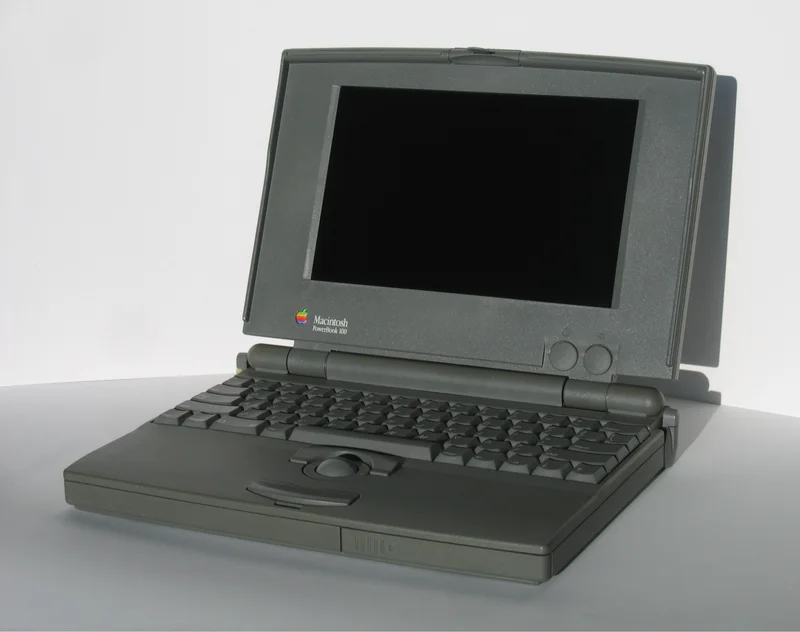
PowerBook 165c
Apple's first color PowerBook. Passive-matrix color TFT, sluggish but a milestone.
The 165c was the first color PowerBook, which is most of what it had going for it. February 10, 1993, a 68030 at 33MHz, System 7.1, and a passive-matrix color screen showing 256 colors. Passive matrix was the problem. Move the mouse quickly and it left trails across the display, scrolling smeared, and the colors looked pale next to anything on a CRT. Apple had shipped color on a laptop before it shipped good color on a laptop. The other costs were weight, battery life and price. Color passive-matrix panels drew considerably more power than the monochrome screens in the 145 and 160, and the 165c cost enough that most people who wanted a PowerBook bought one of those instead. Buyers were early adopters, designers who wanted to check color work away from the studio, and people who liked owning the new thing first. Reviewers were straightforward about it. The achievement was real and the screen was hard to recommend for actual graphics work. The 180c arrived four months later with an active-matrix panel and made the 165c obsolete almost immediately, which is the fate of most first attempts.
Mac History Timeline
Full Specifications
Availability
Processor
Memory
Storage
Display
Graphics
Expansion
Connectivity
Physical
Processor Deep Dive
Motorola 68030
MotorolaThe 165c used a 33MHz 68030, the same solid mid-tier 68000-family processor found across many Macs of this period, here tasked with driving Apple's first color passive-matrix display. Its integrated MMU supported the demands of System 7.1's virtual memory and multitasking features. While competent for general computing, the chip itself was not the bottleneck in this machine, the color screen's refresh limitations were. It remained a dependable, well-understood architecture during the final years before PowerPC's introduction.
Compatible Operating Systems

System 7.1
Launch OS1993
Shipped from the factory as the PowerBook 165c's original operating system.
System 7.5
Compatible1994
Ran adequately though color screen redraws remained a limiting factor rather than the OS itself.
System 7.5.5
Max Supported1996
Considered the reasonable performance ceiling for this early color PowerBook.
Mac OS 7.6.1
Compatible1997
Installable but impractical given the 165c's dated processor and display hardware.
Reviews & Reception
The PowerBook 165c was recognized as a historically important but technically rough first attempt at a color Mac laptop.
Color has finally arrived on a PowerBook, though the passive-matrix screen's ghosting will test the patience of anyone doing serious graphics work on the go.
A landmark machine more for what it represents than how it performs, the 165c is Apple's first real step toward color portability.
Battery life takes a real hit compared to monochrome PowerBooks, a tradeoff early adopters will need to accept for the novelty of color.
Despite its rough edges, the 165c proves color laptops are inevitable, and better implementations are surely just around the corner.