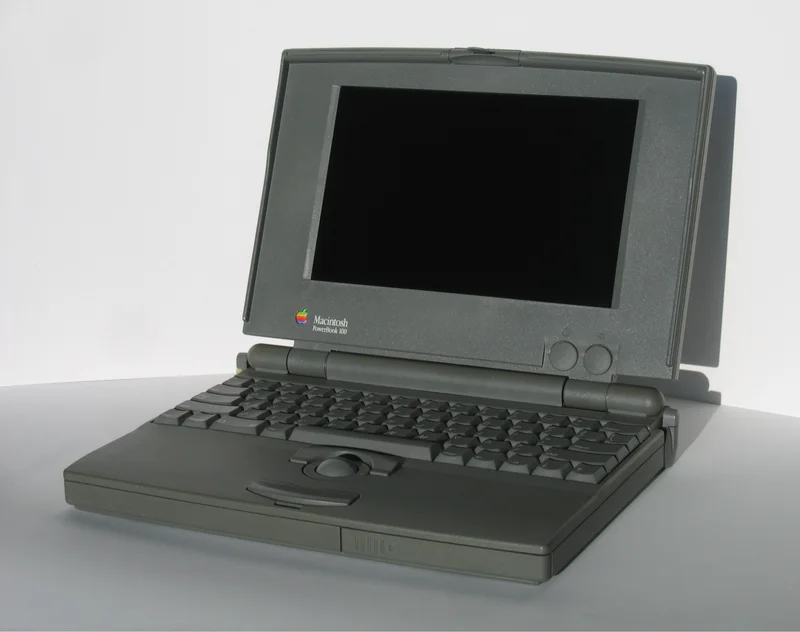
PowerBook 160
Mid-range PowerBook with greyscale display, replacing the 140.
The PowerBook 160 replaced the 140 in the middle of the range on October 19, 1992, keeping the chassis that had defined laptop ergonomics and putting a 68030 at 25MHz and a grayscale screen behind it. Grayscale was the upgrade that mattered day to day. Against the 140's pure monochrome, text and images gained shading and depth, and reading the thing for hours stopped being a chore. It sat below the 33MHz 180 and above the entry-level 145, aimed at professionals and students who wanted something dependable without the top-of-range price. It sold accordingly. Windows laptops at the time were still mostly dim monochrome panels in bulky cases, so Apple's combination of a refined chassis and a crisp grayscale screen stood out. System 7.1 ran well on it, with PowerBook-specific control panels for battery and screen dimming that nobody else had bothered to write. The limits were the usual ones. 25MHz felt pedestrian next to the 180, the passive-matrix panel still ghosted and had narrow viewing angles, battery life was fine rather than good, and expansion came down to one SCSI port and the shared 100-series bay. It outsold most of its generation anyway.
Mac History Timeline
Full Specifications
Availability
Processor
Memory
Storage
Display
Graphics
Expansion
Connectivity
Physical
Processor Deep Dive
Motorola 68030
MotorolaRunning at 25MHz in the PowerBook 160, this 68030 variant balanced power efficiency with adequate performance for mainstream productivity tasks under System 7.1. It featured an integrated MMU that supported the virtual memory features Apple was beginning to emphasize. As the successor to the 68020, it was the standard mid-tier engine across much of Apple's early-1990s desktop and portable lineup. Its mature, well-understood architecture made it a dependable choice for battery-powered devices.
Compatible Operating Systems

System 7.1
Launch OS1992
Original factory operating system for the PowerBook 160.
System 7.5
Compatible1994
Ran well with adequate RAM installed, gaining PowerBook-specific power management improvements.
System 7.5.5
Max Supported1996
Widely regarded as the sensible performance ceiling for this 25MHz 68030 machine.
Mac OS 7.6.1
Compatible1997
Could technically run but felt noticeably sluggish on the 160's modest processor.
Reviews & Reception
The PowerBook 160 was praised as a well-balanced, dependable mid-range portable with a meaningfully improved display.
The greyscale screen alone makes the PowerBook 160 feel like a generational leap over the 140, even though the processor speed hasn't changed dramatically.
A dependable, well-rounded portable that lacks the flash of the 180 but delivers everything most users actually need.
Battery life and build quality remain best in class, though the passive-matrix display shows its limits with fast-moving content.
Apple continues to set the design standard for portable computing, and the 160 is proof that refinement matters as much as raw speed.