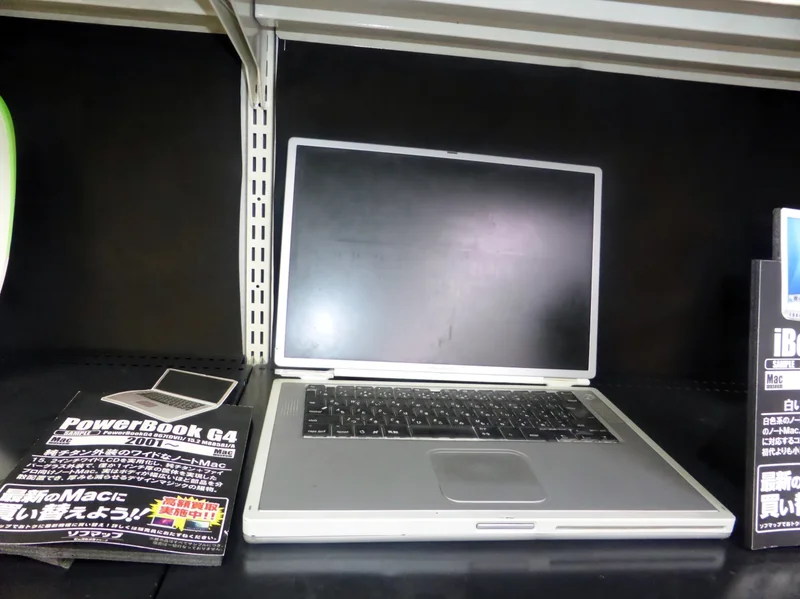
PowerBook G4 (Titanium)
Stunning titanium enclosure wowed the world. World's thinnest laptop at its release.
Jobs pulled it out of a manila envelope at Macworld in January 2001, and at that moment it was the thinnest laptop in the world. Titanium is why. Apple chose the alloy for strength against weight, and it gave the machine a cool gray sheen no plastic laptop could imitate. Everyone called it the TiBook within about a week. The screen was 15.2 inches and widescreen, which no Mac laptop had been, and which looks obvious now and did not then. A PowerPC 7410 G4 started at 400MHz and worked up through 500, 550, 667 and 800 to a final 1GHz version on the 7445 over three years. Against Pentium 4-M and the early Pentium M machines from Dell, Sony and IBM, the TiBook often lost on raw benchmarks and won on everything you could see. It had real faults. The paint chipped around the edges and hinge corners, and the plastic display bezel went brittle and cracked on a lot of units. Apple improved both across revisions without ever quite fixing them. The widescreen display and slot-loading drive both went straight into the aluminum PowerBooks of 2003.
Mac History Timeline
Full Specifications
Availability
Processor
Memory
Storage
Display
Graphics
Expansion
Connectivity
Physical
Processor Deep Dive
PowerPC 7410/7445 (G4)
MotorolaThe 7410 was a low-power derivative of the G4 line built specifically for the thermal constraints of laptops, retaining the AltiVec Velocity Engine for accelerated media tasks while sipping far less power than desktop G4 chips. Later revisions moved to the 7445 as clock speeds climbed from 400MHz to 1GHz across the TiBook's lifespan. Compared to contemporary Intel Pentium 4-M and early Pentium M mobile chips, the G4 offered strong multimedia performance per clock but often trailed in raw integer throughput and battery efficiency. It represented Motorola's best attempt at bringing desktop-class vector processing into a genuinely portable form factor.
Compatible Operating Systems

Mac OS X 10.0
Launch OS2001
Shipped as the factory OS on the original Titanium PowerBook G4.

Mac OS X 10.1
Compatible2001
Major stability and speed update that most early TiBook owners quickly adopted.
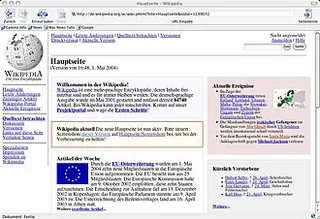
Mac OS X 10.3 Panther
Compatible2003
Widely used on later-model, faster-clocked TiBooks with expanded RAM.

Mac OS X 10.4 Tiger
Compatible2005
Supported on the higher-clocked 667MHz-1GHz TiBook revisions.
Mac OS X 10.5 Leopard
Max Supported2007
Only the 867MHz-and-faster TiBook models meet Leopard's minimum processor requirement.
Reviews & Reception
Widely celebrated as a landmark industrial design achievement, with only minor complaints about finish durability tempering the enthusiasm.
The Titanium PowerBook is not just a laptop, it is a statement piece that happens to run OS X beautifully. Nothing else on the market looks or feels like it.
Apple has built the thinnest, sexiest laptop we have ever tested, though early paint chipping around the edges is a real annoyance for a machine this expensive.
Windows laptops still win on raw benchmarks and battery life, but none of them turn heads the way this titanium marvel does.
The widescreen display and slot-loading drive set a new bar for what a professional laptop should look like.