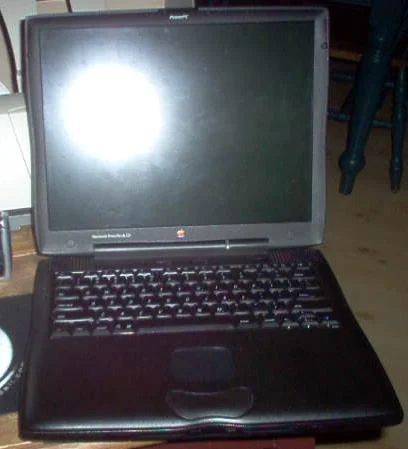
PowerBook G3 (Wallstreet)
A beloved professional workhorse with excellent performance and expandability.
Wallstreet took the Beige G3's performance and put it in a laptop that professionals still talk about. A G3 between 233 and 300MHz under Mac OS 8.1, a 14.1-inch active-matrix screen among the largest and sharpest on any portable, and two expansion bays. Those bays are the reason people loved it. You could carry two batteries, or a battery and a CD-ROM, or a floppy and a Zip drive, and reconfigure the machine on a desk in an airport. Build quality matched. Strong hinges, a good keyboard, ports placed where you would want them, and enough durability that owners were still using them a decade later. Against Pentium II mobile chips the G3 held the same advantage it held on the desktop, so video editors, programmers and designers had a genuinely fast machine away from a desk. Reviewers ranked it among the best laptops on sale at any price, which three years after the 5300 caught fire was a considerable distance traveled. A second revision arrived later in 1998 with higher clocks and better graphics. Lombard and Pismo refined this machine rather than replacing its ideas.
Mac History Timeline
Full Specifications
Availability
Processor
Memory
Storage
Display
Graphics
Expansion
Connectivity
Physical
Processor Deep Dive
PowerPC 750 (G3)
IBM/MotorolaThe PowerPC 750, Apple's G3 chip, brought its short efficient pipeline and large cache design to mobile computing in Wallstreet, running from 233 to 300MHz. It delivered performance that meaningfully outpaced contemporary Pentium II mobile processors in many real-world tasks, a rare feat for a Mac laptop against its Windows rivals at the time. Its power efficiency also suited battery-powered use well, helping Wallstreet balance genuine desktop-class speed with acceptable battery life for a professional laptop of 1998.
Compatible Operating Systems
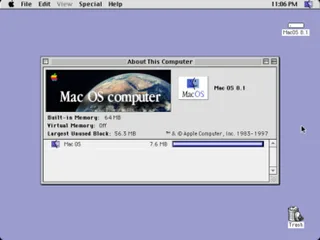
Mac OS 8.1
Launch OS1998
Shipped standard on the Wallstreet PowerBook G3.
Mac OS 8.5
Compatible1998
Added Sherlock search and native PowerPC performance improvements.
Mac OS 8.6
Compatible1999
A popular, stable late-life update for Wallstreet owners.

Mac OS 9.1
Max Supported2000
The generally recommended maximum given Wallstreet's Old World ROM architecture.
Mac OS 9.2.2
Compatible2001
Ran with reduced reliability; officially unsupported due to the Old World ROM's inability to boot Mac OS X.
Reviews & Reception
Wallstreet was met with near-universal acclaim, widely regarded as the finest professional PowerBook of its era and a clear signal of Apple's mobile-computing resurgence.
Wallstreet is simply the best PowerBook Apple has ever made, combining G3 speed, a gorgeous display option, and genuinely flexible expansion bays.
Dual expansion bays mean you can carry a spare battery and a CD-ROM at once, a level of practicality Windows laptop makers still haven't matched.
Apple's new PowerBook trades blows with our fastest Pentium II mobile test units and, in several benchmarks, wins outright.
After the 5300's battery scandal, Apple's laptop reputation needed rebuilding, and Wallstreet does exactly that with speed, style, and solid engineering.