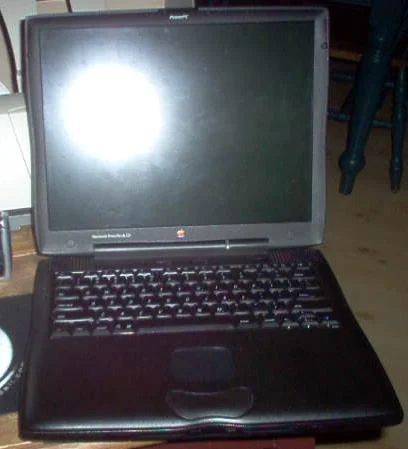
PowerBook G3 (Pismo)
Final PowerBook G3. First to feature FireWire and USB, and AirPort slot. Hugely popular.
Pismo is the one people kept. February 16, 2000, a G3 from 400 to 500MHz under Mac OS 9.0.4, and the first PowerBook with both FireWire and USB as standard. FireWire mattered because DV camcorders did. An editor could shoot on location, plug the camera into the laptop and cut, which had not been possible on a portable Mac before. An internal AirPort slot arrived at the same time, which made this one of the first mainstream laptops built with wireless networking assumed rather than added on. The dual expansion bays carried over from Wallstreet and Lombard, so you could still hot-swap optical drives and batteries, and you could run two batteries at once, which people traveling long distances appreciated a great deal. The G3 was no longer humiliating Intel's mobile chips the way the first ones had. It was fast enough for professional work and nobody complained. New World ROM is why Pismos lasted. They ran Mac OS X natively, so owners kept them for years, and a community grew up fitting faster processors and larger drives long after Apple stopped selling them.
Mac History Timeline
Full Specifications
Availability
Processor
Memory
Storage
Display
Graphics
Expansion
Connectivity
Physical
Processor Deep Dive
PowerPC 750 (G3)
IBM/MotorolaThe PowerPC 750 G3 in Pismo ran from 400 to 500MHz, its most refined mobile implementation, offering dependable performance for professional workloads even as Intel's Pentium III mobile chips had closed much of the earlier performance gap. Its efficient architecture continued to suit battery-powered use well, and combined with Pismo's dual-battery capability, it enabled genuinely long working sessions away from a power outlet. This chip generation's New World ROM compatibility also let Pismo run Mac OS X natively, extending its practical usefulness years beyond its original classic Mac OS launch software.
Compatible Operating Systems

Mac OS 9.0.4
Launch OS2000
Shipped standard on the Pismo PowerBook G3 at introduction.
Mac OS 9.1
Compatible2001
Improved AirPort and FireWire driver support shortly after launch.
Mac OS 9.2.2
Compatible2001
The final and most polished classic Mac OS release for Pismo.

Mac OS X 10.1 Puma
Compatible2001
One of the earliest Mac OS X releases Pismo could run natively thanks to its New World ROM.
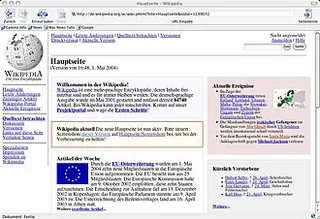
Mac OS X 10.3 Panther
Max Supported2003
Widely regarded as the practical performance ceiling for smooth Mac OS X use on Pismo hardware.
Reviews & Reception
Pismo was met with widespread acclaim as the most complete and future-proof PowerBook G3 yet, prized for pioneering FireWire, USB, and AirPort together in one machine.
Pismo combines FireWire, USB, and built-in AirPort wireless in one beautifully engineered laptop, making it the most complete PowerBook Apple has ever shipped.
Dual battery support and genuine wireless networking together finally make an all-day, cable-free laptop a reality for Mac professionals.
Apple's newest PowerBook holds its own against our favorite Windows notebooks, with connectivity options that are arguably ahead of the competition.
Pismo feels like the PowerBook line finally reaching maturity, fast enough, wireless-ready, and built to last well beyond its shelf life.