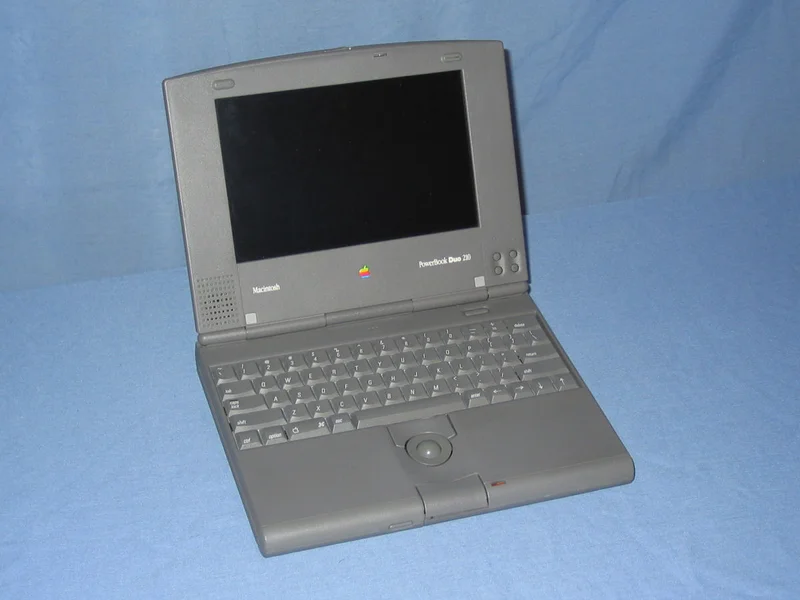
PowerBook Duo 280c
Top-spec Duo with 68040 and active-matrix color display. The best PowerBook Duo made.
The 280c is the best Duo Apple built and the last that mattered. May 16, 1994, a 68040 at 33MHz, and the active-matrix color screen the 270c had introduced a year earlier. The processor is the difference. A full 68040 with an integrated floating-point unit and better caches made this Duo quick enough for real applications and light multimedia rather than just correspondence, and the sub-five-pound chassis did not grow to accommodate it. It still docked. Slide it into a Duo Dock or a MiniDock and it became a desktop, which nothing else on the market did at any price. Reviewers agreed it was the best of the line. They also noted the price, which was the highest Apple had asked for a Duo, and the battery life, which a 68040 and an active-matrix panel between them reduced considerably against the monochrome models. Windows subnotebooks were years from matching that combination of thinness, color quality and docking. Two months earlier Apple had shipped the first PowerPC Macs, which makes the 280c one of the last refined pieces of 68k engineering the company produced while its attention was already elsewhere.
Mac History Timeline
Full Specifications
Availability
Processor
Memory
Storage
Display
Graphics
Expansion
Connectivity
Physical
Processor Deep Dive
Motorola 68040
MotorolaThe Duo 280c's 33MHz 68040 brought the architecture's integrated floating-point unit and dual on-chip caches into Apple's smallest, thinnest PowerBook chassis, a considerable engineering feat given the thermal and power constraints of a subnotebook. Compared to the 68030 used in earlier Duos, it offered substantially improved real-world throughput for demanding applications. This made the 280c the fastest Duo Apple ever released, showcasing just how much performance could be packed into an ultraportable design by 1994. It stands as one of the last and most refined 68k implementations before Apple's PowerPC transition reshaped the entire lineup.
Compatible Operating Systems

System 7.1
Launch OS1994
Shipped from the factory as the Duo 280c's original operating system.
System 7.5
Compatible1994
Ran very well, benefiting from the 280c's fast 68040 processor and active-matrix screen.
System 7.5.5
Max Supported1996
Regarded as the practical performance ceiling for this top-tier 68040 Duo.
Mac OS 7.6.1
Compatible1997
Installable with sufficient RAM but offered diminishing returns on this aging 68k portable.
Reviews & Reception
The Duo 280c was celebrated as the best PowerBook Duo ever made, a fitting high point for the innovative subnotebook line.
The Duo 280c is the finest PowerBook Duo Apple has ever built, combining real 68040 speed with a color screen that finally feels desktop-class.
A genuinely thrilling ultraportable, though the price and battery life demand real commitment from buyers.
No other subnotebook on the market offers this combination of thinness, color quality, and docking flexibility.
The 280c proves the Duo concept still has plenty of room to grow, even as Apple's attention shifts toward PowerPC.