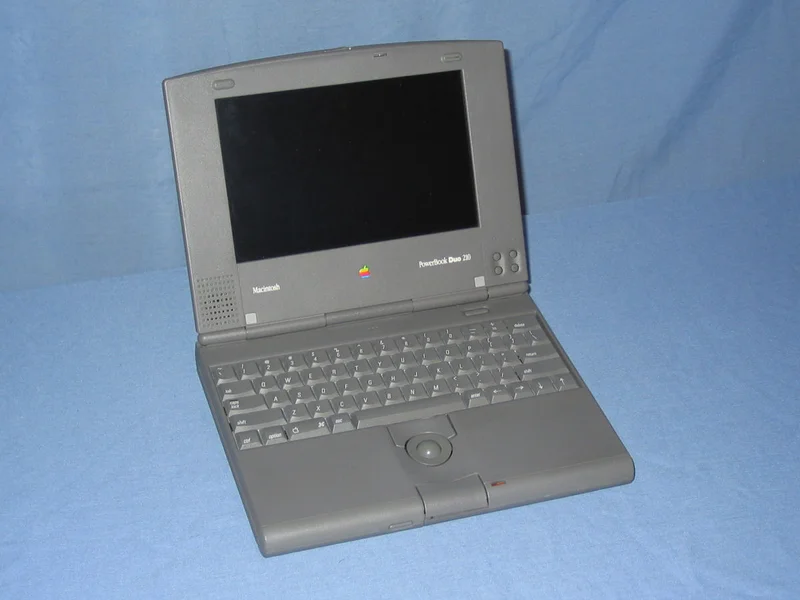
PowerBook Duo 270c
First color Duo. Thin design with optional Duo Dock for full desktop connectivity.
The Duo 270c put an active-matrix color screen into the subnotebook on October 21, 1993, which was the hard part. Fitting that panel into a chassis under five pounds and barely an inch thick was a genuine piece of engineering, and reviewers said so. The 68030 ran at 33MHz, System 7.1 ran on it, and the machine still slid into a Duo Dock and became a color desktop when you got back. That combination had no real competitor. Windows color subnotebooks were rare and compromised on either weight or screen, and nobody else offered the dock transformation at all. Designers, marketing people and executives who presented in color on the road bought them. The Duo compromises did not go anywhere. No floppy, almost no ports without the dock, a cramped keyboard, a small trackball, and a price in premium territory. Battery life suffered the way it did on every color portable that year. Against the 180c it gave comparable screen quality in a much smaller package while giving up processing speed to the 68040 machines arriving elsewhere. Collectors want this one, because an ultraportable with a good color screen in 1993 was a rare thing.
Mac History Timeline
Full Specifications
Availability
Processor
Memory
Storage
Display
Graphics
Expansion
Connectivity
Physical
Processor Deep Dive
Motorola 68030
MotorolaThe Duo 270c used a 33MHz 68030, matched here with Apple's active-matrix color technology in an extraordinarily compact chassis. The chip's integrated MMU supported System 7.1's memory demands while remaining efficient enough for battery-powered subnotebook use. It offered performance comparable to other 33MHz 68030 PowerBooks of the period, though it was not the fastest option available by late 1993. Its role in the 270c demonstrated how far Motorola's mature 68030 design could still be pushed in miniaturized, power-conscious form factors.
Compatible Operating Systems

System 7.1
Launch OS1993
Shipped from the factory as the Duo 270c's original operating system.
System 7.5
Compatible1994
Ran well and took good advantage of the 270c's active-matrix color capabilities.
System 7.5.5
Max Supported1996
Regarded as the practical performance ceiling for this 68030-based color Duo.
Mac OS 7.6.1
Compatible1997
Installable but performance was noticeably strained on the aging 68030 processor.
Reviews & Reception
The Duo 270c was celebrated for bringing genuinely impressive active-matrix color to Apple's thinnest, most portable Mac design.
Apple has managed to squeeze genuine active-matrix color into the thinnest Mac notebook ever made, a remarkable feat of engineering.
The Duo 270c is the color subnotebook power users have been hoping for, though the dock remains an expensive but necessary companion.
Battery life suffers under the weight of the active-matrix screen, a familiar tradeoff across Apple's color PowerBook lineup.
For traveling professionals who present in color, the 270c is worth every ounce of its premium price tag.