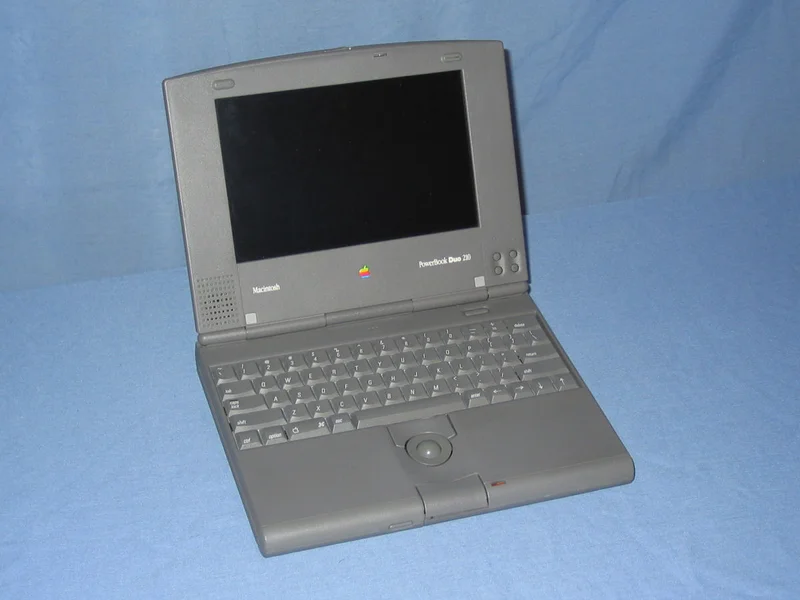
PowerBook Duo 230
Faster Duo with 33MHz 68030. Same slim design, slightly better battery.
The 230 was the faster Duo, a 68030 at 33MHz against the 210's 25, in the same magnesium-reinforced case with the same 9-inch monochrome passive-matrix screen and the same single docking connector. Roughly 30 percent more throughput for a modest premium. That mattered to anyone running System 7.1 with a stack of extensions loaded, which in 1992 was most people, and reviewers recommended the 230 to anyone using a Duo as their only machine rather than as a travel companion. Everything else was Duo. Astonishingly thin for the year, a keyboard and trackball fitted into a footprint nothing else matched, and total dependence on the Duo Dock or MiniDock for an external monitor, expansion, and in some configurations even ADB and serial ports. The trade press admired the engineering of getting a full 68030 logic board into that enclosure. They also noted the small imprecise trackball, expensive and awkward RAM upgrades, and the feeling of being charged twice for accessories you needed to make the machine complete. Consultants and journalists kept them for years. The 230 is the one collectors look for, since it caught the Duo idea at its peak before color screens and 68040s started pushing the thermal and battery limits harder than the design could take.
Mac History Timeline
Full Specifications
Availability
Processor
Memory
Storage
Display
Graphics
Expansion
Connectivity
Physical
Processor Deep Dive
Motorola 68030
MotorolaClocked at 33MHz in the Duo 230, this was one of the higher-speed bins of Motorola's popular third-generation 68000-family chip, offering a meaningful step up from the 210's 25MHz part. It included an on-chip MMU and paged memory management well suited to multitasking under System 7. The 68030 was the dominant mid-range Mac CPU of its era before PowerPC's 1994 arrival. Its efficiency-per-clock made it a strong fit for battery-powered portables like the Duo line.
Compatible Operating Systems

System 7.1
Launch OS1992
The Duo 230 shipped from the factory running System 7.1.
System 7.5
Compatible1994
Performed better than the 210 thanks to its higher clock speed, though extensions still taxed available RAM.
System 7.5.5
Max Supported1996
Considered the realistic upper limit for reliable everyday use on this machine.
Mac OS 7.6.1
Compatible1997
Could be installed but performance gains were minimal given the aging 68030 core.
Reviews & Reception
The Duo 230 was well received as the more capable, speed-focused member of Apple's innovative subnotebook family.
The Duo 230 is the Duo to buy if speed genuinely matters to your workflow, its 33MHz processor noticeably smooths over the rough edges of the 210.
It's remarkable how much machine Apple crammed into this slab, though heavy extension users will still want to max out the RAM.
Apple's docking ecosystem remains unique in the industry, but buyers should budget for the dock alongside the notebook itself.
For consultants who live out of a briefcase, the 230 offers a compelling blend of speed and portability unmatched by DOS-based competitors.