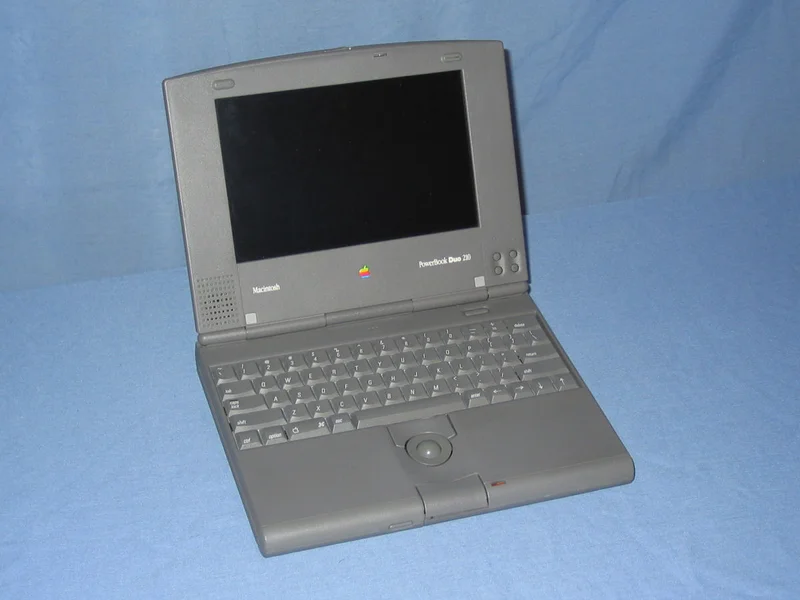
PowerBook Duo 210
Ultra-thin subnotebook Mac requiring a Duo Dock for full connectivity. Pioneered the ultrabook concept.
The Duo 210 shipped October 19, 1992 as the thinnest, lightest and most stripped-down Mac Apple had made. 4.2 pounds, a little over an inch thick, a 68030 at 25MHz and a 9-inch monochrome passive-matrix screen. No floppy drive. Barely any ports. The missing hardware was the point, because the Duo slid into a desktop dock. The Duo Dock swallowed the machine whole and gave it a full monitor, a full keyboard, NuBus slots and more storage, which turned a bare travel computer into a desktop when you got back to the office. Nobody else was doing this, and the idea would not properly return until the MacBook Air and the USB-C dock two decades later. A magnesium internal frame kept the small case stiff. The compromises were real all the same. One Duo-specific expansion connector, a cramped keyboard against the full-size PowerBooks on the same shelf, and no floppy at a time when software arrived on floppies. Against the NEC UltraLite and Compaq's early subnotebooks it was thinner and far better integrated, and it was also the slower of the two Duos launched that day. Executives and consultants bought them. Reviewers admired the ambition and then added up what the docks cost, which was the recurring complaint about the whole line.
Mac History Timeline
Full Specifications
Availability
Processor
Memory
Storage
Display
Graphics
Expansion
Connectivity
Physical
Processor Deep Dive
Motorola 68030
MotorolaThe 68030 was the third generation of Motorola's 68000 family, adding an integrated MMU and expanded cache over the 68020, making it well suited to battery-conscious portable designs like the Duo. Running at 25MHz in the Duo 210, it delivered modest but adequate performance for System 7 productivity work. It represented the mainstream mid-tier Mac CPU choice through the early 1990s before PowerPC arrived. Its legacy lives on as the workhorse chip of the classic Mac II and PowerBook eras.
Compatible Operating Systems

System 7.1
Launch OS1992
Shipped as the original operating system on the PowerBook Duo 210.
System 7.5
Compatible1994
Ran acceptably with sufficient RAM, adding PowerTalk and drag-and-drop features.
System 7.5.5
Max Supported1996
Generally regarded as the practical ceiling for smooth performance on this 68030 subnotebook.
Mac OS 7.6.1
Compatible1997
Technically installable but sluggish given the Duo 210's limited RAM ceiling and 25MHz processor.
Reviews & Reception
The Duo 210 was praised as a visionary ultraportable let down slightly by the added cost and complexity of its docking ecosystem.
The Duo 210 feels like a glimpse of the future, a notebook so small you forget it's a real Mac until you dock it and a full system springs to life.
Apple's docking concept is brilliant in theory, but the cost of the Duo Dock nearly doubles the investment needed for full functionality.
At just over four pounds, the Duo 210 redefines what a business traveler can expect from a Macintosh notebook, even if the screen strains the eyes in dim cabins.
The lack of a built-in floppy drive will frustrate users accustomed to the standard PowerBook line, though the tradeoff in weight is undeniably worth it for frequent flyers.