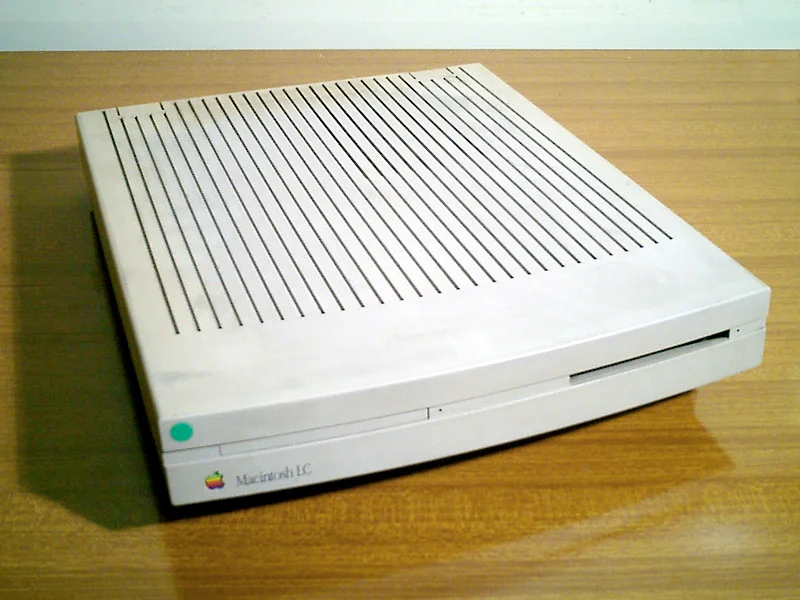
Macintosh LC III
Faster LC with 25MHz 68030. Supported up to 16-bit color at 640×480.
The LC III arrived February 10, 1993 with a 68030 at 25MHz, which finally gave the LC line a processor worth having after two generations of 68020. Graphics improved too. 16-bit color at 640x480 on a compatible display, which mattered because educational software and the CD-ROM multimedia titles arriving at the time were built around color, and the LC II had made them look poor. The case did not change. Same low pizza box, same LC-compatible expansion slot, same market of schools, families and small businesses who wanted a real Mac running System 7.1 at a price they could reach. It was not fast. A 25MHz 68030 was modest even in 1993, particularly against the 68040 Quadras, and the integrated video took its memory from system RAM, which capped what resolutions and color depths you could actually use. For the people buying it, none of that was the point. Educators and reviewers liked it, LC III+ variants followed with faster clocks, and the chassis stayed central to Apple's low-end strategy for years. Against cheap PC clones the LC III had better software and better multimedia out of the box, which is how Apple held onto American classrooms through the early 1990s.
Mac History Timeline
Full Specifications
Availability
Processor
Memory
Storage
Display
Graphics
Expansion
Connectivity
Physical
Processor Deep Dive
Motorola 68030
MotorolaThe LC III's 25MHz 68030 replaced the 68020 used in earlier LC models, bringing an integrated MMU and improved instruction throughput to Apple's budget desktop line. This upgrade allowed the LC III to comfortably run System 7.1 with better multitasking headroom than its predecessors. It was a mature, well-proven chip by 1993, offering reliability and reasonable efficiency for cost-sensitive designs. Its presence in the LC III reflected Apple's strategy of trickling down proven silicon into affordable machines.
Compatible Operating Systems

System 7.1
Launch OS1993
The LC III shipped from Apple running System 7.1 out of the box.
System 7.5
Compatible1994
Ran reasonably well, though users needed to manage RAM carefully given the LC III's typical memory configurations.
System 7.5.5
Max Supported1996
Considered the practical performance ceiling for this 25MHz 68030 compact Mac.
Mac OS 7.6.1
Compatible1997
Could be installed but performance was noticeably strained on the LC III's modest hardware.
Reviews & Reception
The LC III was well regarded as a solid, affordable step forward for Apple's education and home-focused compact desktop line.
The LC III's color video improvements make a real difference for classroom multimedia, finally doing justice to CD-ROM educational titles.
A solid, if unspectacular, upgrade that delivers exactly the kind of value Apple's education customers have come to expect.
The shared-memory video architecture limits its ceiling, but for the price the LC III remains hard to beat.
Apple continues to dominate the education computing space, and the LC III's color capabilities only strengthen that grip.