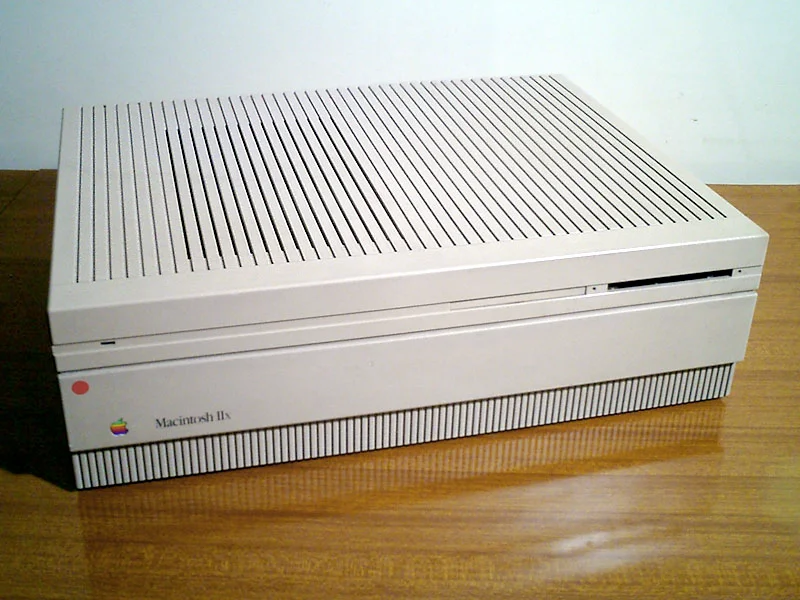
Macintosh IIx
Upgraded Mac II with 68030 processor and 1.44MB SuperDrive. More powerful but in same chassis.
Apple announced the IIx on September 19, 1988 as a straight replacement for the Macintosh II, with a 68030 in place of the 68020 and the clock speed left at 16MHz. The spec sheet therefore looked like nothing had happened. The 68030 brought an integrated memory management unit and a better internal design, which showed up in virtual memory and multitasking rather than in anything you could point at on a benchmark chart. The SuperDrive was the more visible change. 1.44MB high-density floppies, and the ability to read MS-DOS disks, which mattered in any office running both platforms. Six NuBus slots and the modular chassis carried over unchanged, so publishers and engineering departments got what they already had plus a socket for a 68882 floating-point coprocessor. Reviewers found it sensible and dull. With the clock speed unmoved the gains were architectural, and more than one critic asked whether the price over a plain Mac II was worth paying. People who needed the MMU thought so, as did anyone doing CAD or financial modeling who wanted the FPU socket. The IIx held the top of the line for two years while Apple built the IIci and the IIfx, which ran the same 68030 far faster and got most of the attention.
Mac History Timeline
Full Specifications
Availability
Processor
Memory
Storage
Display
Graphics
Expansion
Connectivity
Physical
Processor Deep Dive
Motorola 68030
MotorolaThe 68030 built on the 68020's fully 32-bit design by integrating a paged memory management unit directly onto the chip, eliminating the need for a separate 68851 PMMU and improving virtual memory performance considerably. It also added a small internal data cache alongside its instruction cache, improving throughput on many workloads even at equivalent clock speeds to the 68020. At 16MHz in the IIx it offered modest but real gains over the Mac II's 68020, and its integrated MMU made it far better suited to the multitasking and virtual memory features that later System software releases would depend on. It became the standard processor across most of Apple's mid-range and professional Macs through the early 1990s.
Compatible Operating Systems
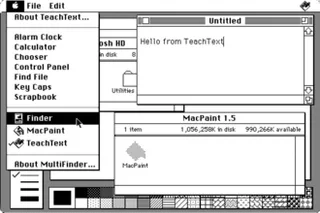
System 6.0.1
Launch OS1988
Shipped with the IIx, the first System release to properly support its FDHD SuperDrive.
System 6.0.8
Compatible1991
A mature and stable release taking full advantage of the 68030's capabilities.

System 7.5.5
Max Supported1996
Achievable with maximum RAM, though official Apple support ended at System 7.1.
Reviews & Reception
Regarded as a sound but incremental upgrade, valued for its 68030 architecture and SuperDrive but seen as a bridge toward faster machines to come.
The IIx brings the 68030 and its integrated memory management to the Mac II line, a meaningful architectural upgrade even if the clock speed looks unchanged on paper.
For engineering and scientific users who need virtual memory and floating point performance, the IIx is a genuine step forward over the original Mac II.
The performance gains are real but subtle, and buyers may wonder whether the premium over a Mac II is worth it for typical office tasks.
A solid, professional-grade update, though it feels more like a stepping stone toward faster 68030 Macs still to come.