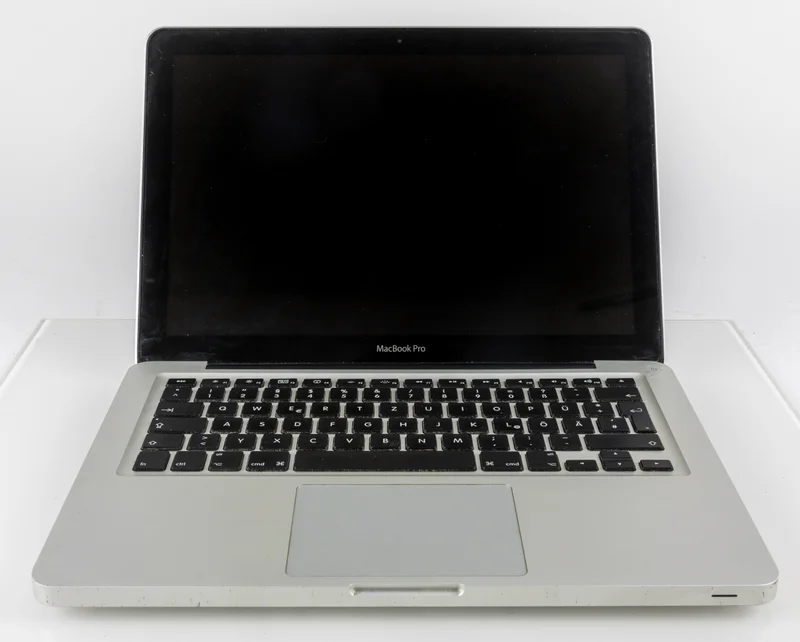
MacBook Pro (Unibody, Late 2008)
First unibody MacBook Pro. CNC-machined aluminum enclosure was revolutionary in manufacturing.
Apple started milling laptops out of solid aluminum on October 14, 2008, and has not really stopped since. The unibody process took a single block of aluminum and hollowed it out with CNC machines, forming the lid, the keyboard deck and the internal chassis as one continuous piece. That was aerospace manufacturing applied to a consumer product, and it replaced the riveted and bonded panels every previous MacBook Pro had used. The result was far stiffer and considerably harder to break. The trackpad grew and lost its button, the whole glass surface depressing to click, which took a week to stop feeling strange and then felt obvious. The display gained a black glass bezel and LED backlighting and lost the matte option entirely, and professional users who worked near windows complained loudly enough that Apple brought matte back the following year. Inside were the same Penryn Core 2 Duo chips as before at 2.4 and 2.53GHz, so the processor barely moved. Graphics did, with an NVIDIA GeForce 9400M and an optional discrete 9600M GT. The battery in this first unibody was still user-replaceable. Later ones were not. Everything else about how this machine was made went on to define every MacBook since.
Mac History Timeline
Full Specifications
Availability
Processor
Memory
Storage
Display
Graphics
Expansion
Connectivity
Physical
Processor Deep Dive
Intel Core 2 Duo (Penryn)
IntelThe first unibody MacBook Pro used the same 45nm Penryn-generation Core 2 Duo chips introduced earlier in 2008, running at 2.4GHz and 2.53GHz, so CPU performance itself was largely a continuation rather than a leap. The bigger architectural story on this machine was the new NVIDIA GeForce 9400M integrated graphics paired alongside it, which meaningfully improved graphics throughput compared to Intel's previous integrated graphics options. Against AMD's mobile chip offerings of the era, Penryn maintained Intel's established efficiency and performance advantage. This generation's real historical significance lies in its enclosure manufacturing and graphics pairing rather than in CPU architecture itself.
Compatible Operating Systems
Mac OS X 10.5 Leopard
Launch OS2008
Shipped running Leopard 10.5.5.
Mac OS X 10.6 Snow Leopard
Compatible2009
Ran very well, benefiting from GeForce 9400M graphics acceleration.

Mac OS X 10.7 Lion
Compatible2011
Fully supported on this generation.

OS X 10.11 El Capitan
Max Supported2015
Commonly cited as the official ceiling, with some later unsupported patched installs pushing further unofficially.
Reviews & Reception
Celebrated near-universally as a manufacturing and design breakthrough, with only the glossy-only display drawing consistent complaints.
Milling the entire body from a single block of aluminum sounds like overkill until you pick this thing up and feel how solid it is.
The new glass trackpad is a joy to use, though the glossy-only screen option will frustrate some professionals.
This is a genuine manufacturing breakthrough disguised as a routine laptop refresh, and it shows in every seam, or rather, the total absence of them.
The 9400M graphics chipset is a real upgrade for creative work and casual gaming alike, even if raw CPU speed hasn't moved much.