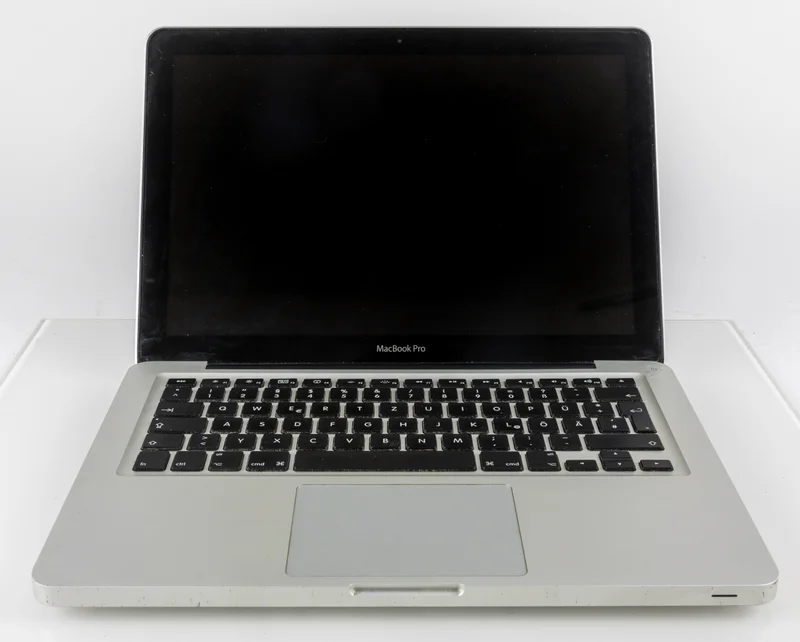
MacBook Pro 14"/16" (M4 Pro/Max, 2024)
M4 generation with Thunderbolt 5 and nano-texture display option. New black finish for Max models.
More of the same, done well, with two additions worth having. Thunderbolt 5 arrived first on any Mac, which matters if you drive high-resolution external displays or fast storage arrays for a living. The nano-texture display option came across from the Pro Display XDR. Etched glass rather than a coating, which cuts reflections dramatically for anyone working in a bright room, at the cost of very slightly softer fine text that a few reviewers noticed and most thought worth it. The base M4 gained a CPU core over the entry M3, which quietly fixed the tier confusion from the year before. M4 Pro and Max scaled up CPU, GPU and memory bandwidth as usual, with a larger Neural Engine aimed at the on-device Apple Intelligence features arriving in macOS Sequoia. Battery life improved modestly. Reviewers treated it as further evidence the MacBook Pro had found stable ground after the butterfly years, and told M3 Pro owners there was no hurry.
Mac History Timeline
Full Specifications
Availability
Processor
Memory
Storage
Display
Graphics
Expansion
Connectivity
Physical
Processor Deep Dive
Apple M4 / M4 Pro / M4 Max
AppleBuilt on an advanced second-generation 3nm process, the M4 family increased CPU core counts and Neural Engine capability significantly over M3, with M4 Max scaling up to a 16-core CPU and 40-core GPU alongside substantial memory bandwidth for professional creative workloads. Against Intel Core Ultra and AMD Ryzen AI mobile chips of the era, the M4 family extended Apple Silicon's efficiency and sustained-performance advantage further, particularly for on-device AI features tied to Apple Intelligence. This generation also enabled Thunderbolt 5 connectivity, a first for any Mac, reflecting the chip's expanded I/O capabilities.
Compatible Operating Systems

macOS Sequoia 15.1
Launch OS2024
Launched as the debut OS for the M4 family MacBook Pro.
macOS Sequoia 15
Compatible2024
Continued to receive updates with expanding Apple Intelligence features.
macOS Sequoia 15
Compatible2025
Remains actively supported and updated as of the most recent macOS releases.
Reviews & Reception
The M4 MacBook Pro was well received for its thoughtful professional-focused additions like Thunderbolt 5 and nano-texture display, continuing the line's reputation for steady, trusted refinement.
Thunderbolt 5 and the nano-texture display option are genuinely useful, thoughtful additions rather than marketing checkboxes, even if the overall design remains familiar.
M4 Max is an absolute powerhouse for video and 3D work, though M3 Pro and Max owners have little urgent reason to upgrade based on raw performance alone.
The nano-texture matte finish is a lovely option for anyone working near windows or bright studio lighting, and it's great to see it trickle down from the Pro Display XDR.
This is the MacBook Pro continuing to do what it does best: steady, trustworthy, professional-focused refinement of an already excellent machine.