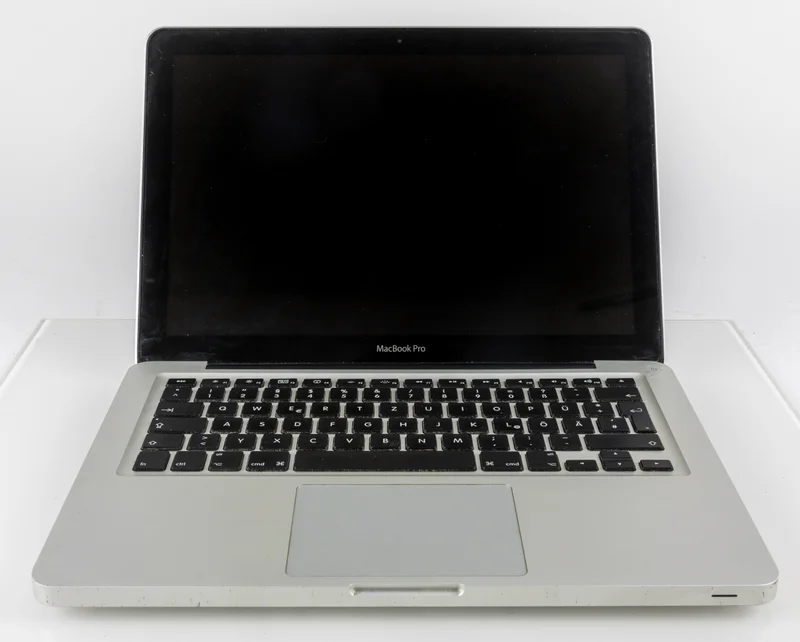
MacBook Pro 14"/16" (M3/Pro/Max, 2023)
First MacBook Pro with Space Black. M3 brings hardware ray tracing and significant CPU gains.
A refinement, not a reinvention. The color did most of the talking. Space Black used a new anodizing process built to resist the fingerprints that had ruined every dark Apple laptop finish before it, and it became the most requested option in the line almost immediately. The M3 family was built on TSMC's 3-nanometer process and brought the first hardware-accelerated ray tracing and mesh shading in any Mac, plus dynamic caching, which allocates GPU memory on demand rather than reserving it and improves utilization considerably. There was some confusion at the bottom of the range. The base 14-inch M3 model drove only two external displays and shipped with a dimmer non-XDR panel, and reviewers spent paragraphs explaining which tier did what. Multi-core gains over M1 Pro and Max were real and modest, which is what a maturing yearly cadence looks like rather than the jump from Intel. Single-core and graphics moved more, particularly for ray-traced work. Reviewers liked it and told M1 Pro owners to stay put.
Mac History Timeline
Full Specifications
Availability
Processor
Memory
Storage
Display
Graphics
Expansion
Connectivity
Physical
Processor Deep Dive
Apple M3 / M3 Pro / M3 Max
AppleBuilt on TSMC's advanced 3nm process, the M3 family introduced hardware-accelerated ray tracing, mesh shading, and dynamic caching for improved GPU efficiency, alongside faster CPU cores than the M1 generation. Against Intel 13th-generation and AMD Ryzen 7040-series mobile chips, the M3 family extended Apple Silicon's substantial efficiency lead while adding genuinely new graphics capabilities competitive with dedicated mobile GPUs for the first time. M3 Max scaled up to a 16-core CPU and 40-core GPU, offering serious workstation-class performance for the most demanding creative professionals.
Compatible Operating Systems

macOS Sonoma 14.1
Launch OS2023
Launched as the debut OS for the M3 family MacBook Pro.
macOS Sonoma 14
Compatible2023
Continued to receive updates with desktop widgets and gaming improvements.

macOS Sequoia 15
Compatible2024
Brought Apple Intelligence features fully supported by this M3 hardware.
macOS Sequoia 15
Compatible2025
Remains actively supported and updated as of the most recent macOS releases.
Reviews & Reception
The M3 MacBook Pro was well received as a polished, incremental refinement, notable mainly for its new Space Black finish and first-ever hardware ray tracing support.
Space Black is a gorgeous new finish, and the new ray tracing support is a genuinely useful addition for 3D and gaming workloads, even if the generational leap feels more evolutionary this time.
M3 Max is a serious performer, but M1 Pro and M1 Max owners shouldn't feel any urgency to upgrade based on these numbers alone.
The entry-level M3 configuration's display and display-support limitations created some confusing tiering, but the core hardware and new Space Black finish remain excellent.
This is Apple refining an already great formula rather than reinventing it, and the new 3-nanometer chips bring real, if incremental, gains across the board.