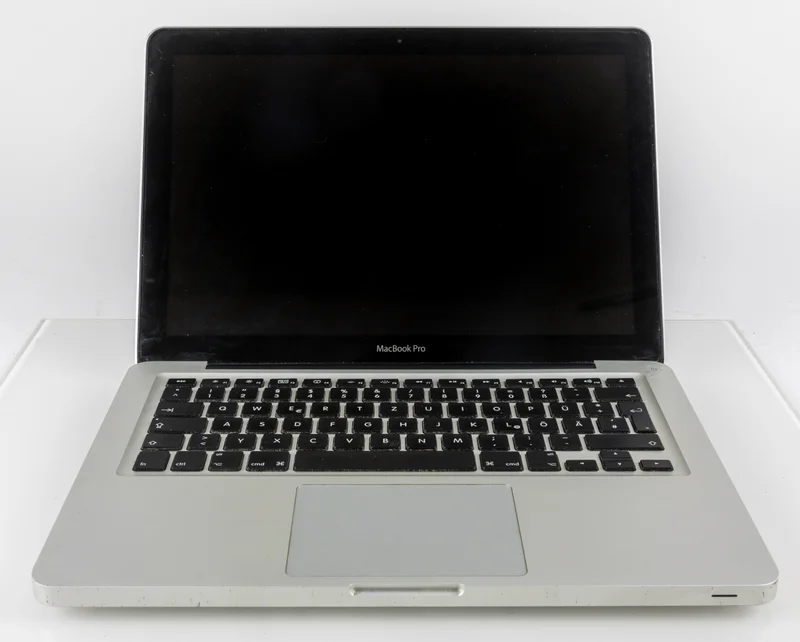
MacBook Pro 13" (M2, 2022)
M2 in the classic 13-inch body. Last MBP without notch or ProMotion.
This is the awkward one. Apple put M2 into the 2016 chassis, kept the Touch Bar that the rest of the Pro line had already abandoned, and shipped it with two Thunderbolt ports where the redesigned models had four. No MagSafe, no HDMI, no SD slot, no mini-LED display. M2 did bring genuine gains over the M1 13-inch Pro, particularly on graphics and sustained work, helped by active cooling and a bigger battery. It handles a long export slightly better than the fanless Air. That was a thin argument. Months later the redesigned M2 Air arrived with a larger, brighter screen, MagSafe and a modern shape, for less money, and the obvious question was why this machine existed at all. Reviewers were polite and unenthusiastic. Most called it a placeholder, there to hold a price point until Apple had something proper. Apple retired the chassis and the Touch Bar within about a year, folding the entry Pro tier into the 14-inch M3. This is the last of the old design, and nobody misses it.
Mac History Timeline
Full Specifications
Availability
Processor
Memory
Storage
Display
Graphics
Expansion
Connectivity
Physical
Processor Deep Dive
Apple M2
AppleThe same enhanced 5nm M2 chip used in the redesigned MacBook Air, here benefiting from active cooling in the older 13-inch Pro chassis to sustain slightly higher performance during longer creative workloads. Against Intel 12th-generation and AMD Ryzen 6000-series mobile chips of the time, M2 maintained Apple Silicon's substantial efficiency and performance-per-watt lead, though the modest generational gain over M1 did little to distinguish this particular machine from its Air sibling. M2's real limitation here wasn't the chip itself but the aging chassis Apple chose to keep it in.
Compatible Operating Systems

macOS Monterey 12.4
Launch OS2022
Launched as the debut OS for the M2 13-inch MacBook Pro.

macOS Ventura 13
Compatible2022
Added Stage Manager and Continuity Camera support shortly after launch.

macOS Sonoma 14
Compatible2023
Continued full support with desktop widgets and improved gaming APIs.

macOS Sequoia 15
Compatible2024
Brought Apple Intelligence features to this transitional Touch Bar model.
macOS Sequoia 15
Compatible2025
Remains actively supported and updated as of the most recent macOS releases.
Reviews & Reception
The M2 13-inch MacBook Pro was widely viewed as a lukewarm, transitional release, criticized for retaining an outdated chassis and Touch Bar just as the redesigned MacBook Air made it feel obsolete.
It's a strange machine to review in 2022. Why does a brand-new MacBook Pro still have a Touch Bar and only two ports when the cheaper Air just got a total redesign?
M2 is a genuinely capable chip, and active cooling gives it a slight edge over the Air in sustained workloads, but the chassis around it feels like a relic at this point.
This feels like a placeholder release rather than a machine Apple is genuinely excited about, and most buyers would be better served waiting or buying the redesigned Air instead.
There's nothing wrong with the performance here, but it's hard to recommend this over the new Air unless you specifically need the extra sustained performance from active cooling.