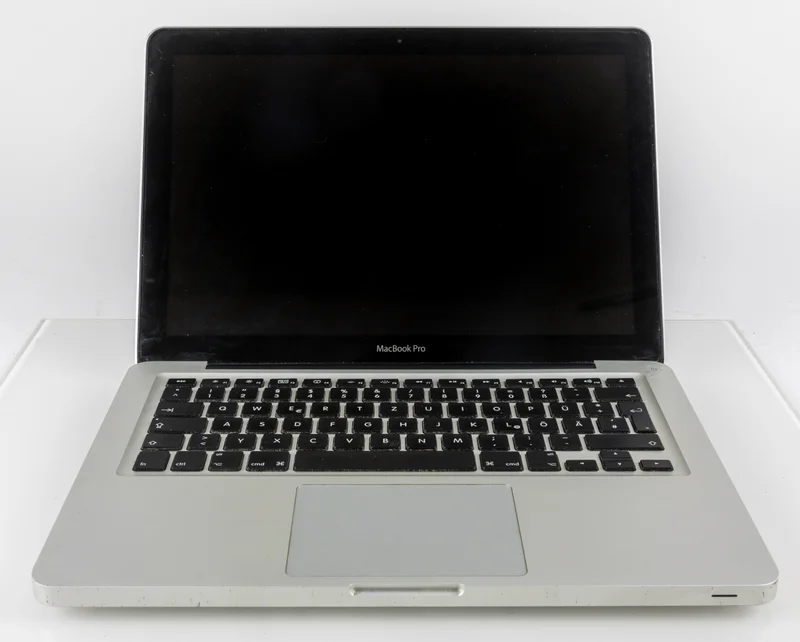
MacBook Pro 14"/16" (M1 Pro/Max, 2021)
Return of MagSafe, HDMI, SD card, and notch display. ProMotion 120Hz. Widely regarded as the greatest laptop ever made.
Apple gave back everything it had taken away since 2016, then added silicon nobody could match. MagSafe returned. So did HDMI and an SD card slot, alongside more Thunderbolt 4 ports, which ended five years of dongles in a single announcement. The display was new too. Mini-LED Liquid Retina XDR with ProMotion up to 120Hz, bringing true HDR contrast that had previously required Apple's Pro Display XDR. The case got thicker and heavier to make room for the ports and better cooling, and a notch appeared at the top of the screen to hold the improved webcam. People argued about the notch and mostly stopped. Then the chips. M1 Pro and M1 Max scaled the architecture up hard, with M1 Max running a 10-core CPU, up to a 32-core GPU and enormous memory bandwidth. Editors found they could scrub and export several streams of 8K ProRes that would have stopped an Intel machine dead, on battery, without the fans becoming audible. Reviewers called it a victory lap. No Windows laptop on Intel or AMD silicon came close at anything like the same power draw.
Mac History Timeline
Full Specifications
Availability
Processor
Memory
Storage
Display
Graphics
Expansion
Connectivity
Physical
Processor Deep Dive
Apple M1 Pro / M1 Max
AppleThese scaled-up 5nm Apple Silicon chips featured a 10-core CPU (8 performance, 2 efficiency) alongside up to a 16-core GPU on M1 Pro or a 32-core GPU on M1 Max, with vastly increased unified memory bandwidth reaching 200GB/s and 400GB/s respectively. Compared to the best contemporary Intel and AMD mobile workstation chips, M1 Pro and Max delivered comparable or superior sustained performance at a fraction of the power draw and heat output, a gap competitors would spend years trying to close. This generation proved Apple Silicon could scale from efficient everyday laptops all the way to genuine professional workstation-class performance.
Compatible Operating Systems
macOS Monterey 12.0.1
Launch OS2021
Launched as the debut OS for the redesigned M1 Pro/Max MacBook Pro.

macOS Ventura 13
Compatible2022
Added Stage Manager, well suited to this model's large XDR display.

macOS Sonoma 14
Compatible2023
Continued full support with desktop widgets and improved gaming APIs.

macOS Sequoia 15
Compatible2024
Brought numerous Apple Intelligence features to this pro-tier hardware.
macOS Sequoia 15
Compatible2025
Remains actively supported and updated as of the most recent macOS releases.
Reviews & Reception
The M1 Pro/Max MacBook Pro was hailed almost unanimously as a landmark course-correction and the most powerful, complete pro laptop Apple had ever produced.
Apple brought back MagSafe, HDMI, and an SD card slot, and paired it with the most powerful laptop chip I've ever tested. This is everything the MacBook Pro should have been since 2016.
M1 Max renders and exports video at speeds that used to require a loud, tethered desktop workstation. Doing this on battery power is genuinely remarkable.
The notch is a small, forgivable quirk in an otherwise triumphant redesign that finally gives professional users the ports and display they've been asking for.
No Windows laptop, Intel or AMD, comes close to this performance-per-watt. Apple has built the best pro laptop of the decade, full stop.