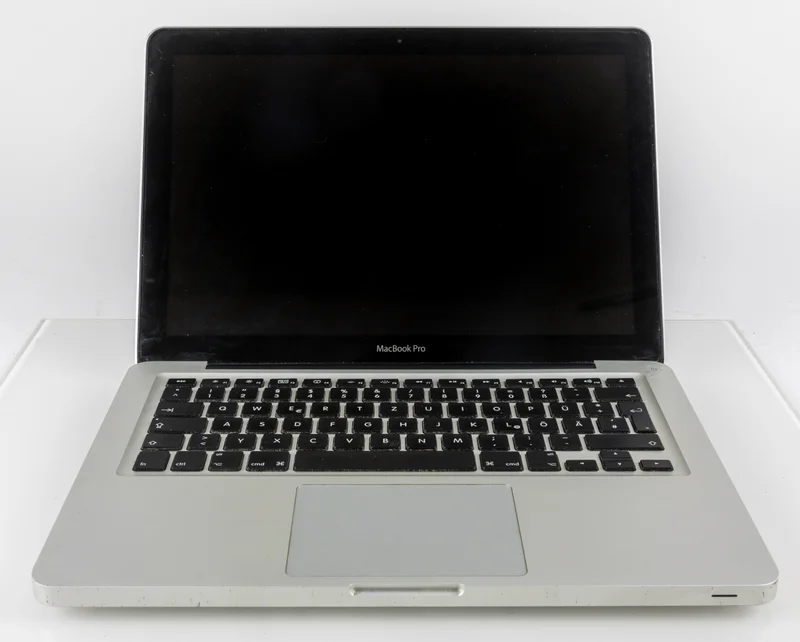
MacBook Pro (Early 2008)
Last non-unibody MacBook Pro. Penryn chips and multi-touch trackpad added.
The last MacBook Pro before the unibody, and the first with a multi-touch trackpad. That trackpad is why this generation is worth remembering. Pinch to zoom, rotate and swipe, taken conceptually from the iPhone that had launched the previous summer, and a clear step past the single-finger and two-finger scrolling that came before. Nothing on a Windows laptop came close for years. Intel's 45nm Penryn Core 2 Duo ran at 2.4 or 2.6GHz, which was a sensible rather than dramatic improvement, alongside larger RAM options and the first solid-state drive option in the Pro line. LED backlighting arrived across the range too, improving brightness and color while drawing less power than the fluorescent tubes it replaced. Reviewers treated it as a competent internal refresh and said the outside was looking tired after two unchanged years of riveted aluminum panels, with the single-piece construction already rumored. It arrived in February 2008. Apple replaced the entire manufacturing process in October. That makes this the final chapter of the classic aluminum MacBook Pro that had started in 2006.
Mac History Timeline
Full Specifications
Availability
Processor
Memory
Storage
Display
Graphics
Expansion
Connectivity
Physical
Processor Deep Dive
Intel Core 2 Duo (Penryn)
IntelPenryn was Intel's 45nm die shrink of the Core microarchitecture, delivering improved clock speeds, a larger shared cache, and better power efficiency compared to the previous 65nm Merom generation. It introduced SSE4 instructions that benefited some media encoding and scientific workloads. Against AMD's competing mobile Turion chips of the period, Penryn maintained Intel's clear performance and efficiency lead in laptops. It represented a mature, refined endpoint of the Core 2 Duo era just before Intel's Nehalem architecture would reshape the landscape the following year.
Compatible Operating Systems
Mac OS X 10.5 Leopard
Launch OS2008
Shipped running Leopard 10.5.2.
Mac OS X 10.6 Snow Leopard
Compatible2009
Ran smoothly, taking advantage of 64-bit Penryn architecture.

Mac OS X 10.7 Lion
Compatible2011
Officially supported on this generation.
OS X 10.11 El Capitan
Max Supported2015
Widely cited as the last officially supported release for this pre-unibody generation.
Reviews & Reception
Viewed as a solid, if visually familiar, refresh distinguished chiefly by its innovative multi-touch trackpad.
The multi-touch trackpad alone makes this feel like a genuinely new laptop, even though the exterior hasn't changed much.
Penryn brings welcome efficiency gains, though the overall design is clearly nearing the end of its run.
Pinch-to-zoom and rotate gestures on a trackpad feel like magic the first time you try them.
A safe, competent update rather than a dramatic leap, but the multi-touch trackpad is a genuine differentiator.