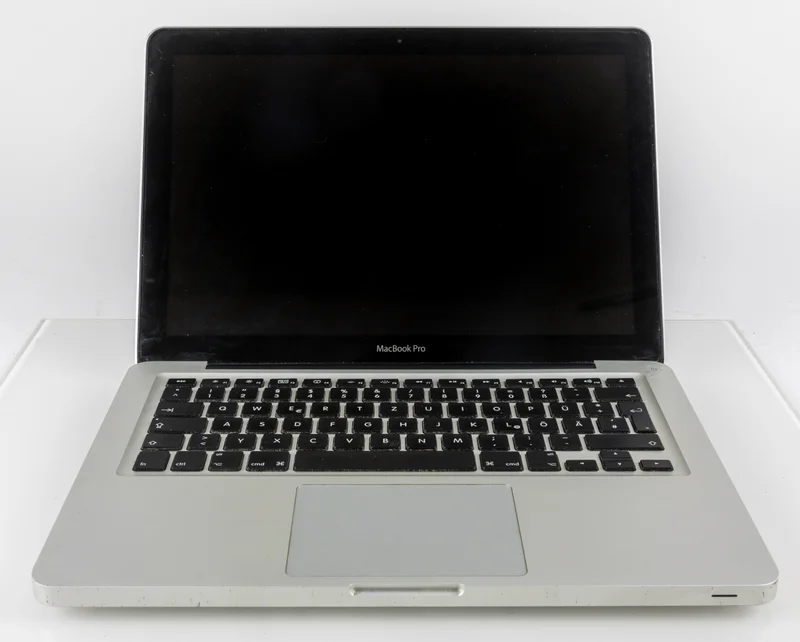
MacBook Pro (Early 2006)
First professional Intel laptop from Apple. Replaced the PowerBook G4. Introduced MagSafe charging.
The first MacBook Pro replaced the PowerBook G4 in January 2006 and brought two things that outlasted it. MagSafe was the first. A magnetic power connector that let go when someone tripped over the cable, instead of taking the laptop off the desk with it. Apple dropped it for USB-C in 2016, then brought it back in 2021, which tells you how right it had been the first time. The iSight camera was the second, and video calling on a laptop stopped needing an accessory. An Intel Core Duo from 1.67 to 2.16GHz replaced the G4, and the difference on floating-point and threaded work was not subtle. Early units ran hot and fell short of Apple's battery estimates, which drew complaints and eventually a firmware fix. The case was the PowerBook's brushed aluminum, riveted and bonded rather than milled from a single block, and it kept the 15-inch widescreen and the glowing logo. Editors, designers and developers bought them, then waited. Final Cut Pro and Photoshop took months to arrive as Universal Binaries, and until they did, the fastest Mac laptop ever made ran the professional software slowly through Rosetta.
Mac History Timeline
Full Specifications
Availability
Processor
Memory
Storage
Display
Graphics
Expansion
Connectivity
Physical
Processor Deep Dive
Intel Core Duo (Yonah)
IntelThe same Yonah-based Core Duo used in the Intel iMac powered the first MacBook Pro, giving Apple's flagship laptop a dual-core, 65nm processor with far better efficiency than the PowerPC G4 chips it replaced. It lacked 64-bit extensions, a limitation that would later cap its operating system lifespan earlier than its Core 2 Duo successor. Competitively it stood alongside Intel's own Pentium M-derived mobile chips used by PC laptop makers at the time, offering similar performance in a notably more polished chassis. Its main legacy is enabling Apple's professional line to make the Intel leap without sacrificing thermal or battery characteristics too badly, aside from some early teething problems.
Compatible Operating Systems

Mac OS X 10.4 Tiger
Launch OS2006
Launched running Intel-native Tiger 10.4.4.
Mac OS X 10.5 Leopard
Compatible2007
Fully supported with good performance improvements.
Mac OS X 10.6 Snow Leopard
Max Supported2009
Last officially supported release due to the 32-bit-only Core Duo processor.
Reviews & Reception
Praised for its speed and innovative MagSafe design, with some early criticism of heat and battery life.
MagSafe alone might be worth the upgrade, but paired with Intel's Core Duo the new MacBook Pro is a genuine leap over the PowerBook G4.
It runs hotter than we'd like and battery life falls short of Apple's claims, but there's no denying this is the fastest Mac laptop ever made.
The MagSafe connector is such an obviously good idea you wonder why no one thought of it sooner.
Creative professionals waiting on native versions of their favorite apps may want to hold off, but the hardware itself is a triumph.