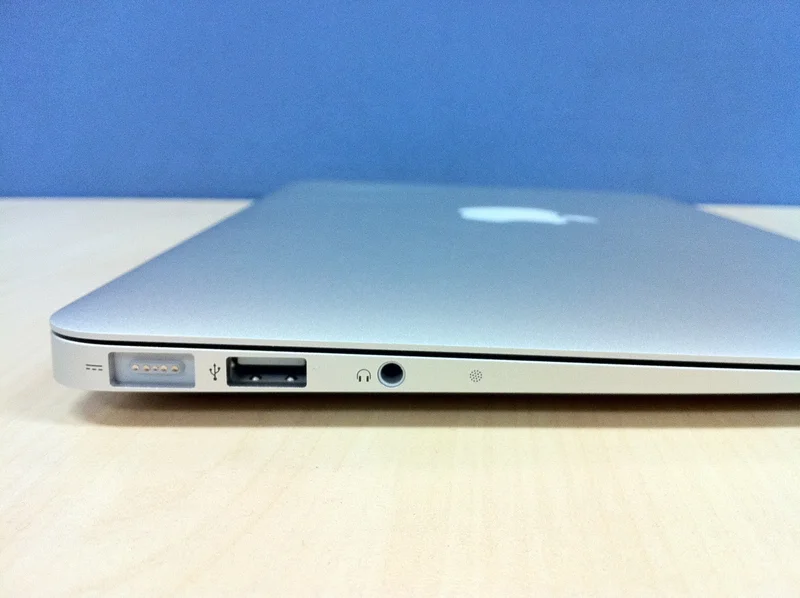
MacBook Air (M1, 2020)
Launched the Apple Silicon era. Fanless design with extraordinary 18-hour battery life. Industry-changing performance-per-watt.
A fanless laptop that beat the Intel one it replaced on nearly every benchmark and lasted roughly twice as long on a charge. Apple announced it in November 2020, alongside the M1 MacBook Pro and mini, and the Air was the clearest demonstration of what M1 actually was, because it had no fan at all. Video exports and Xcode compiles ran in silence, which no laptop had managed. M1 was built on TSMC's 5-nanometer process with 16 billion transistors, putting CPU, GPU and Neural Engine on one chip with unified memory. That is what removed the compromise the Air had lived with for a decade, where thin and silent meant slow. Rosetta 2 translated Intel software well enough that most people could not tell. Reviewers were straightforwardly stunned, and comparisons to the 1998 iMac and the first Retina MacBook Pro started appearing within days. The first year had rough edges. Native versions of major professional applications took time, and virtualization, older plugins and some audio and video tools broke in ways that took months to resolve. None of it mattered much. A $999 laptop had changed what the number meant.
Mac History Timeline
Full Specifications
Availability
Processor
Memory
Storage
Display
Graphics
Expansion
Connectivity
Physical
Processor Deep Dive
Apple M1
AppleApple's first Mac system-on-chip fused an 8-core CPU (4 high-performance, 4 high-efficiency cores), an 8-core GPU, a 16-core Neural Engine, and unified memory shared directly between CPU and GPU onto a single 5nm die, eliminating the latency and power overhead of traditional discrete component designs. This unified-memory ARM architecture delivered dramatically better performance-per-watt than any contemporary x86 chip from Intel or AMD, allowing full workstation-class responsiveness in a completely fanless, silent laptop for the first time. M1's arrival is widely regarded as the moment that shattered the assumption that x86 was required for serious laptop performance, sending shockwaves through Intel's and AMD's mobile roadmaps.
Compatible Operating Systems

macOS Big Sur 11.0.1
Launch OS2020
Launched as the first macOS built to natively support Apple Silicon.

macOS Monterey 12
Compatible2021
Brought Universal Control and Shortcuts app support to the M1 Air.

macOS Ventura 13
Compatible2022
Added Stage Manager, though with some feature limitations on M1 hardware.

macOS Sonoma 14
Compatible2023
Continued full support with widgets on the desktop and improved gaming APIs.

macOS Sequoia 15
Compatible2024
Brought Apple Intelligence features, many requiring M1 or later hardware.
macOS Sequoia 15
Compatible2025
Remains actively supported and updated as of the most recent macOS releases.
Reviews & Reception
The M1 MacBook Air received near-universal ecstatic acclaim, widely hailed as a landmark moment that proved Apple Silicon's transition was an unqualified triumph.
I've never used a laptop that does this. The M1 MacBook Air runs circles around its Intel predecessor with a fan it doesn't even have, and the battery life is simply absurd.
This is not an incremental update, it's a fundamental reset of what people should expect from a laptop processor. Rosetta 2 translation is so good that most users will never notice they're running emulated apps.
Apple just made every other thin-and-light laptop on the market look obsolete overnight, and it did it with the cheapest MacBook in the lineup.
The performance-per-watt story here is almost hard to believe until you use it yourself. This is the most important MacBook Air update since the line began.