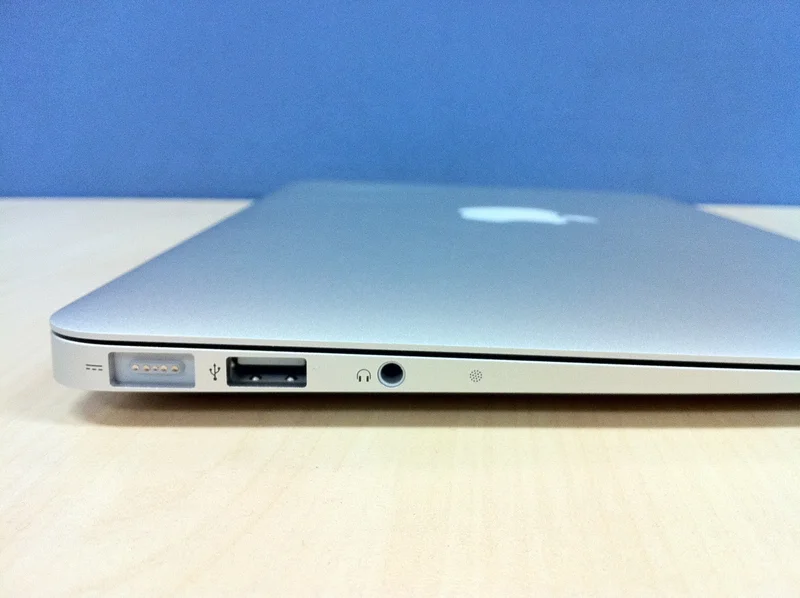
MacBook Air (Mid 2011)
Backlit keyboard and Thunderbolt added to the iconic ultrabook. First i-series MacBook Air.
The 2011 Air is where the hardware finally caught up with the design. Core i5 and i7 Sandy Bridge processors replaced the Core 2 Duo chips that had somehow survived even the acclaimed 2010 redesign, and the gap between the Air and the MacBook Pro narrowed sharply, particularly on multitasking and anything using the much better integrated graphics. A backlit keyboard arrived, which the Pro had always had and the 2010 Air conspicuously had not, and which people had been asking for loudly. Thunderbolt came too, making this and the 2011 iMac the first Macs to carry it. The outside did not change at all. Apple spent this generation on internals, which was the right call, because the wedge was already finished. Reviewers treated it as the update that made the Air a legitimate main computer rather than an excellent second one, and developers and professionals started buying them alongside the travelers and students. The thermal ceiling was still real. Sustained heavy work still favored a MacBook Pro, and for almost everything else the distinction stopped mattering.
Mac History Timeline
Full Specifications
Availability
Processor
Memory
Storage
Display
Graphics
Expansion
Connectivity
Physical
Processor Deep Dive
Intel Core i5 / Core i7 (Sandy Bridge, ULV)
IntelThe 2011 MacBook Air adopted ultra-low-voltage variants of Intel's Sandy Bridge Core i5 and i7 processors, running from 1.6GHz to 1.8GHz base clock but with Turbo Boost pushing considerably higher under demanding single-threaded workloads. This represented a decisive architectural upgrade over the Core 2 Duo chips used in the acclaimed 2010 Air redesign, bringing integrated graphics improvements and better per-core efficiency to the ultraportable line for the first time. It offered a meaningfully better balance of performance and battery efficiency than AMD's competing ultraportable-class offerings at the time. This chip generation effectively brought the MacBook Air's internal capabilities into parity with the broader Mac lineup's architectural direction.
Compatible Operating Systems

Mac OS X 10.7 Lion
Launch OS2011
Shipped running Lion 10.7, the first MacBook Air generation to launch with Lion pre-installed.

OS X 10.9 Mavericks
Compatible2013
Ran well, taking full advantage of Sandy Bridge's efficient architecture.

OS X 10.12 Sierra
Compatible2016
Officially supported on this generation.

OS X 10.13 High Sierra
Max Supported2017
Widely cited as the official maximum supported release for this MacBook Air generation.
Reviews & Reception
Praised as the update that finally made the Air a fully credible primary computer, closing the performance gap that lingered even after the celebrated 2010 redesign.
Sandy Bridge finally makes the Air feel like a full-fledged computer rather than a beautiful compromise.
A backlit keyboard and Thunderbolt round out a genuinely significant internal upgrade, even with the same exterior as last year.
This is now good enough to be most people's only computer, full stop.
Sustained heavy workloads still show the Air's thermal limits compared to a MacBook Pro, but for everyday use that rarely matters.