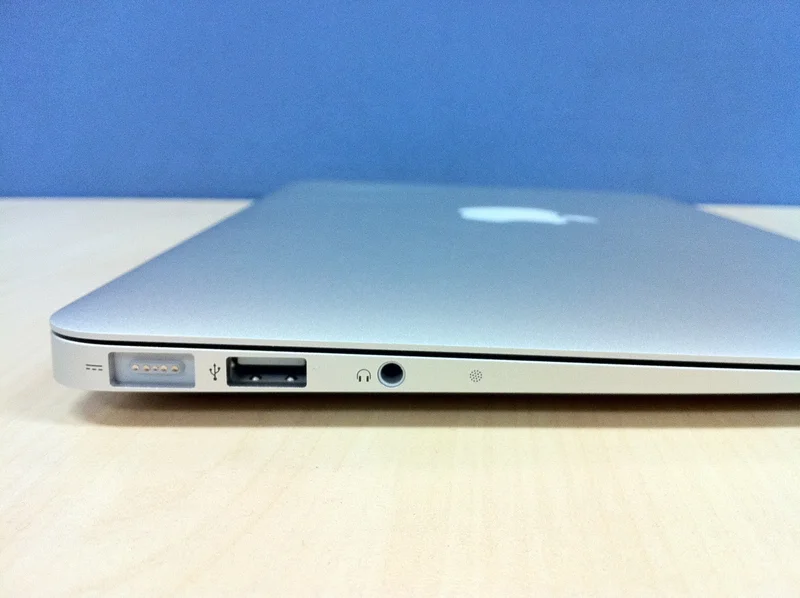
MacBook Air (Late 2010)
Completely redesigned ultralight with flash storage standard. Defined the modern ultrabook.
The 2010 Air is where the idea stopped being a demonstration and started being a laptop you would actually buy. Apple fixed almost every complaint about the 2008 model. An 11.6-inch size joined the 13.3-inch. Flash storage became standard across the line rather than a costly option, which falling SSD prices had finally made possible. A second USB port arrived, answering the most mocked limitation of the original, and the 13-inch got an SD slot. Waking was instant. That single quality changed how the machine felt more than any specification, because opening the lid and having it there is closer to a tablet than to a laptop that boots. The processors were Core 2 Duo from 1.4 to 2.13GHz, which was not Apple's fastest architecture at the time, since Core i5 and i7 were already in the MacBook Pro. Apple traded that for thinness and thermal headroom, and reviewers who wanted more CPU said so. It sold to students, travelers and ordinary people in a way the 2008 model never did, and Intel launched its Ultrabook program the following year explicitly modeled on it, pushing every PC manufacturer to chase a category Apple had invented on its own.
Mac History Timeline
Full Specifications
Availability
Processor
Memory
Storage
Display
Graphics
Expansion
Connectivity
Physical
Processor Deep Dive
Intel Core 2 Duo (custom low-voltage)
IntelThe 2010 MacBook Air continued using low-voltage Core 2 Duo processors rather than Intel's newer Core i-series Arrandale chips already available in other Mac laptops, a deliberate choice to preserve thermal and battery efficiency within the Air's extremely thin chassis. Clock speeds ranged from 1.4GHz on the 11-inch model up to 2.13GHz on higher-end 13-inch configurations. While this meant the Air lagged behind contemporary MacBook Pro models in raw CPU benchmarks, real-world responsiveness benefited enormously from standard flash storage, often making the machine feel faster in daily use than its specifications suggested. This was among the final mainstream Apple laptop designs to rely on the aging Core 2 Duo family before Apple's lineup fully transitioned to Intel's Core i-series the following year.
Compatible Operating Systems
Mac OS X 10.6 Snow Leopard
Launch OS2010
Shipped running Snow Leopard 10.6.4.

Mac OS X 10.7 Lion
Compatible2011
Fully supported, and the Air's SSD made Lion's resume-and-restore features feel especially fast.
OS X 10.8 Mountain Lion
Compatible2012
Ran well on this hardware.

OS X 10.13 High Sierra
Max Supported2017
Widely cited as the official maximum supported release for this MacBook Air generation.
Reviews & Reception
Widely hailed as the redesign that turned the MacBook Air from a niche showpiece into a mainstream favorite, with processor choice as the lone recurring quibble.
This is the MacBook Air that should have existed in 2008: fast to wake, genuinely portable, and no longer defined by its compromises.
Standard flash storage and a second USB port fix the two biggest complaints about the original, and the 11-inch model is a delight.
Core 2 Duo feels like a step behind Apple's own MacBook Pro lineup, but in daily use the SSD more than makes up for it.
This redesign is the moment the MacBook Air becomes a laptop we'd genuinely recommend to almost anyone.