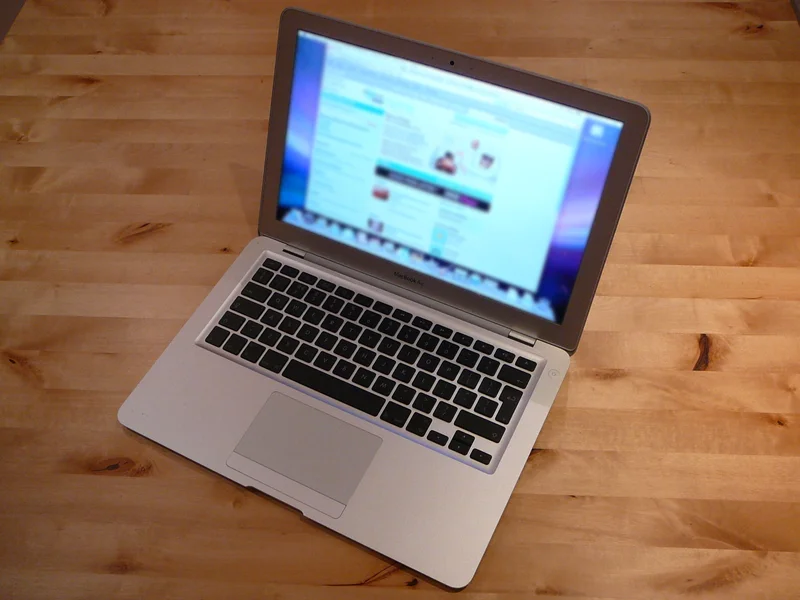
MacBook Air (2008)
Pulled from a manila envelope on stage by Steve Jobs. World's thinnest laptop at launch. An icon of minimalism.
Jobs slid it out of a manila envelope on stage, which is the part everyone remembers. January 15, 2008. The thinnest notebook anyone had built, tapering from 0.16 inches at the front edge to 0.76 at the back, with a full-size keyboard and a 13.3-inch screen inside a wedge of aluminum. Getting there cost almost everything else. There was no optical drive, which no mainstream laptop had done before and which people argued about for a year, one USB port, no Ethernet, and a battery you could not remove. All of it started at $1,799. The processor was a custom underclocked Core 2 Duo at 1.6 or 1.8GHz, and you could option a 64GB solid-state drive instead of the 80GB spinning disk. Almost nobody did, because of what SSDs cost in 2008, and it was obvious even then which way that would go. Reviewers divided exactly as you would expect. The engineering impressed everyone and the compromises annoyed the people who had to use it: constant port juggling, a separate external SuperDrive, unremarkable battery life, and performance behind the ordinary MacBook. It sold modestly and it mattered enormously. Intel coined the word ultrabook years later to describe PC manufacturers copying it.
Mac History Timeline
Full Specifications
Availability
Processor
Memory
Storage
Display
Graphics
Expansion
Connectivity
Physical
Processor Deep Dive
Intel Core 2 Duo (custom low-voltage, Merom)
IntelIntel built a special reduced-size package of the Core 2 Duo specifically for the MacBook Air, shrinking the chip package footprint by roughly 60 percent to fit Apple's ultra-thin wedge chassis. Clocked conservatively at 1.6GHz or 1.8GHz to manage heat in such a constrained enclosure, it traded some raw performance for the physical space savings that made the Air's design possible at all. It was noticeably slower in real-world use than the standard-voltage Core 2 Duo chips in the contemporary MacBook and MacBook Pro. Its legacy lies less in performance than in proving that a full x86 Intel processor could be packaged small enough to enable an entirely new class of ultraportable laptop.
Compatible Operating Systems
Mac OS X 10.5 Leopard
Launch OS2008
Shipped with Leopard 10.5.1, tuned for the Air's unique hardware.
Mac OS X 10.6 Snow Leopard
Compatible2009
Ran well and improved efficiency on the underclocked processor.

Mac OS X 10.7 Lion
Max Supported2011
Official maximum supported release for the first-generation MacBook Air.
Reviews & Reception
A landmark, widely celebrated design reveal undercut in early reviews by real practical compromises around ports, performance, and price.
Pulling a laptop out of an envelope shouldn't feel like a magic trick, but that's exactly what Steve Jobs just did.
A single USB port, no optical drive, and a steep price make this a stunning showpiece but a hard sell as anyone's only computer.
The thinness is real and genuinely impressive, but the underclocked processor means you're paying a premium for looks over speed.
This isn't a laptop for everyone, and Apple knows it, but as a statement about where computing is headed, it's unmistakable.