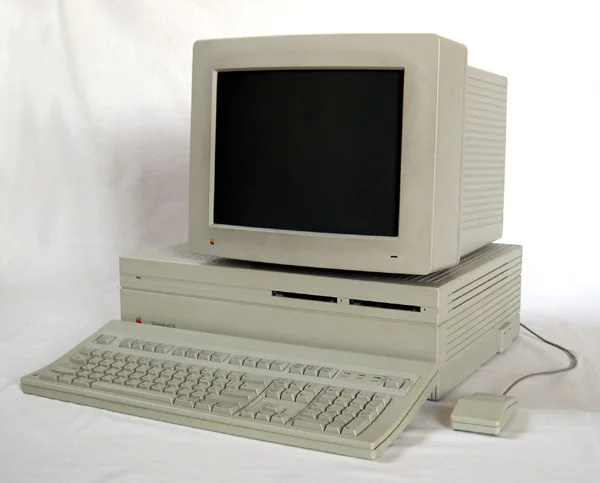
Macintosh II
First Mac with color support. Modular design with NuBus expansion slots, aimed at professional markets.
The Macintosh II arrived March 2, 1987 and threw out nearly everything that had defined a Mac. No sealed all-in-one case. A modular desktop box, a separate monitor, six NuBus expansion slots, and color. The processor was a 68020 at 16MHz, more than double the 68000's clock and a considerably better architecture besides, which was enough to put the Macintosh in the same conversation as Sun workstations and high-end PC clones for the first time. Color was the part that changed the business. An optional video card driving a large external display made color desktop publishing, professional graphics, CAD and scientific visualization possible on a Mac, and none of that had been available on a 9-inch monochrome screen at any price. The slots mattered just as much. Third parties filled them with accelerators, extra video cards and networking hardware, which turned the Mac from an appliance into something you could extend, and power users who had spent three years locked out of their own computers took this rather well. It cost over $5,000 in a normal configuration, so it went to publishers, universities and engineering firms rather than homes. Reviewers liked the speed and the expandability and pointed out that most existing Mac software had been written for one fixed monochrome screen and needed work before it made sense in color. Apple shipped it the same morning as the SE, which set the pattern the company still follows of selling an affordable familiar machine and an expensive expandable one side by side. The IIx, IIcx, IIci and IIfx all came out of this chassis.
Mac History Timeline
Full Specifications
Availability
Processor
Memory
Storage
Display
Graphics
Expansion
Connectivity
Physical
Processor Deep Dive
Motorola 68020
MotorolaThe 68020 was Motorola's first fully 32-bit processor in the 68k family, with a 32-bit external data bus and address bus, an on-chip instruction cache, and a more sophisticated instruction set than its 68000 predecessor. Running at 16MHz in the Mac II, it offered roughly two to three times the real-world performance of the 68000-based compact Macs, enabling far more demanding graphics and computation work. It lacked an integrated floating point unit or memory management unit, both of which had to be added via separate coprocessor chips like the 68881 and 68851 on Mac II expansion configurations. It represented a major architectural leap that positioned the Mac II as a genuine workstation-class machine for its era.
Compatible Operating Systems
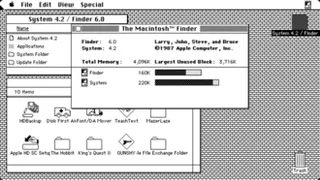
System 4.1
Launch OS1987
Shipped with the Mac II, adding Color QuickDraw support for its new video capabilities.
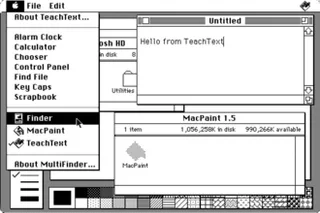
System 6.0.8
Compatible1991
A mature, widely used release well suited to the Mac II's 68020 and expansion options.

System 7.5.5
Max Supported1996
The practical ceiling with an accelerator or maximum RAM, though official support ended earlier at System 7.1.
Reviews & Reception
Hailed as a transformative, workstation-class Macintosh that proved the platform could scale to serious professional use, tempered only by its high price.
The Macintosh II is a genuine workstation wrapped in familiar Mac clothing, with color graphics and expansion slots that finally answer the platform's harshest critics.
This is the machine that proves the Macintosh architecture can scale to serious professional work, though the price will keep it out of most homes.
Color, speed, and NuBus expansion make the Mac II a legitimate rival to engineering workstations, even if software has yet to fully exploit its capabilities.
An impressive machine on paper, but at this price it competes with far more established workstation vendors who already have mature color software ecosystems.