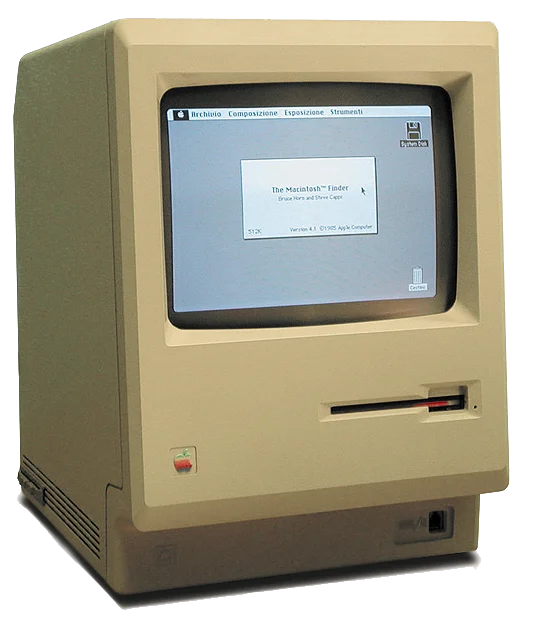
Macintosh 128K
The original Macintosh that changed personal computing forever. Introduced the graphical user interface and mouse to the masses.
Apple launched the Macintosh on January 24, 1984, two days after the Ridley Scott commercial ran during the Super Bowl, with Steve Jobs lifting the machine out of a canvas bag on stage. The Lisa had done the mouse and the windows a year earlier at $9,995. The Macintosh did them at $2,495, and that gap is most of why people remember one machine and not the other. Jerry Manock's case stood the computer upright and gave it a face, which put it at odds with every beige box and green terminal in the room. Inside sat a Motorola 68000 at 7.83MHz and 128 kilobytes of RAM. The RAM was the problem. System software, screen buffer and application code between them left so little room that MacWrite and MacPaint were about the limit, and with one 400K floppy you spent a genuinely irritating amount of 1984 swapping disks. 512x342, black and white, bitmapped, with proportional fonts that looked like typesetting next to the character grids on an IBM PC. Menus, icons, a pointer you moved with your hand. Nearly every personal computer interface since has been a variation on what shipped in that case. The complaints were real and Apple heard all of them. No expansion, no hard disk support, and a case sealed with Torx screws to keep owners out, which was Jobs insisting on control of the whole widget. Sales cooled once the launch noise faded, held back by the thin software library and that RAM ceiling, and the platform only became properly usable with the 512K later that year. None of which dented the thing's significance. Desktop publishing, the mouse, icons and windows all arrived in the mainstream through this machine, and Apple has been arguing with and returning to its design philosophy ever since.
Mac History Timeline
Full Specifications
Availability
Processor
Memory
Storage
Display
Graphics
Expansion
Connectivity
Physical
Processor Deep Dive
Motorola 68000
MotorolaThe 68000 was Motorola's first entry in the 68k family, using a 32-bit internal architecture with a 16-bit external data bus, giving it a large flat 24-bit address space unusual for its era. It offered a clean, orthogonal instruction set that made it a favorite among programmers and was also used in the Commodore Amiga, Atari ST, and Sega Genesis. Compared to the Intel 8088 found in early IBM PCs, the 68000 offered more registers and a more elegant programming model, though the Mac's implementation was hamstrung by limited RAM. It became the foundation for Apple's entire compact Mac lineage through the late 1980s.
Compatible Operating Systems
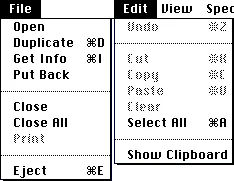
System 1.0
Launch OS1984
Shipped on the original 128K with the Finder, MacWrite, and MacPaint.
System 1.1
Compatible1984
Minor bug-fix update still usable on the 128K's limited memory.
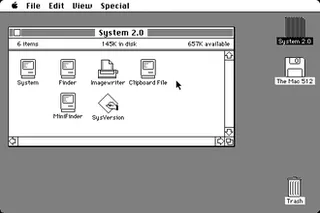
System 2.0
Max Supported1985
The 128K's 128 kilobytes of RAM made this roughly the practical ceiling for reliable operation.
Reviews & Reception
Widely hailed as visionary and revolutionary, though contemporary reviewers consistently flagged the 128K's memory limitations as a serious practical drawback.
The Macintosh is the most exciting thing to happen to computing since the microprocessor itself, though its memory constraints will frustrate anyone hoping to do serious work.
Apple has built an interface so intuitive that first-time users are typing and drawing within minutes, but 128K of memory feels like a cruel joke on such an ambitious machine.
This is not just a new computer, it is a new way of thinking about computers, and every rival will spend the next decade catching up.
Impressive as a demonstration of what graphical computing can be, but at this price and with this little expandability, business buyers will look elsewhere.