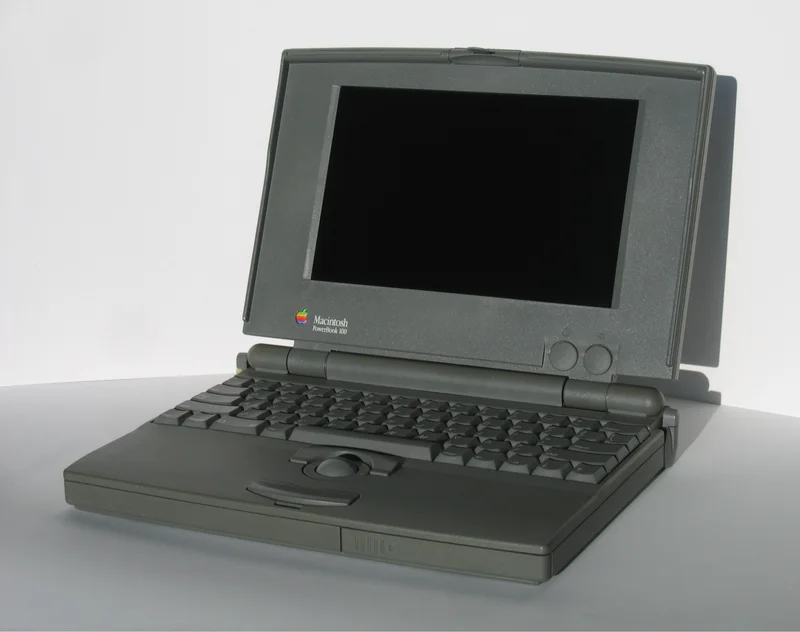
Macintosh 100 (PowerBook 100)
Apple's first truly portable Mac. Developed with Sony, it established the modern laptop form factor with trackball.
The PowerBook 100 shipped October 21, 1991 with the 140 and the 170, and it settled what a laptop looks like. Sony did much of the manufacturing and mechanical engineering. Between them Apple and Sony pushed the keyboard to the back of the case and put a palm rest and a centered trackball in front of it. Every laptop since has done this. At the time, portable PCs put the keyboard at the front edge and the pointing device wherever it fitted, and using one was worse in a way people had stopped noticing until this turned up. The internals were the weakest of the three. A 68000 at 15.667MHz rather than the 68030 in its siblings, which made it slower, lighter, cheaper and easier on the battery. The 10-inch passive-matrix screen was nowhere near the 170's active matrix. None of that mattered much. It weighed little enough to carry, ran for a few hours, and felt like a laptop rather than the 16-pound Macintosh Portable of two years earlier. Writers, students and anyone traveling bought them. It was the cheapest of the three and sold accordingly, and its contribution was industrial design rather than silicon: rear keyboard, palm rest, pointing device in the middle, which is the shape of the machine you are probably reading this on.
Mac History Timeline
Full Specifications
Availability
Processor
Memory
Storage
Display
Graphics
Expansion
Connectivity
Physical
Processor Deep Dive
Motorola 68000
MotorolaThe PowerBook 100 used a low-power 15.667MHz variant of the 68000, chosen specifically for its favorable power efficiency in a battery-powered laptop rather than for raw performance. This made it noticeably slower than its 68030-based PowerBook 140 and 170 siblings launched the same day, positioning it as the entry-level, lightweight option in the lineup. Its architecture was otherwise identical to the chip that had powered every compact Mac since 1984, ensuring full software compatibility despite the modest clock speed. The tradeoff of performance for battery life and weight proved to be the right call for a machine whose real innovation was ergonomic rather than computational.
Compatible Operating Systems

System 7.0.1
Launch OS1991
Shipped with the PowerBook 100, Apple's first System 7 release tuned for portable hardware.
System 7.1
Compatible1992
Ran acceptably with sufficient RAM, though the 68000 limited overall responsiveness.
System 7.5.5
Max Supported1996
The practical ceiling given the PowerBook 100's modest 68000 processor and RAM limits.
Reviews & Reception
Celebrated for its groundbreaking ergonomic layout and portability, with only its modest 68000-based performance drawing mild criticism.
The PowerBook 100's keyboard and trackball placement feels immediately natural, a genuine ergonomic breakthrough that other laptop makers will surely copy.
Modest performance compared to its siblings, but the lightweight design and long battery life make it the PowerBook to actually carry around.
Apple and Sony have quietly redefined what a laptop should look like, and the industry will be catching up to this layout for years.
The 68000 processor feels dated even at launch, but for portable word processing and light tasks the PowerBook 100 is hard to beat on comfort.