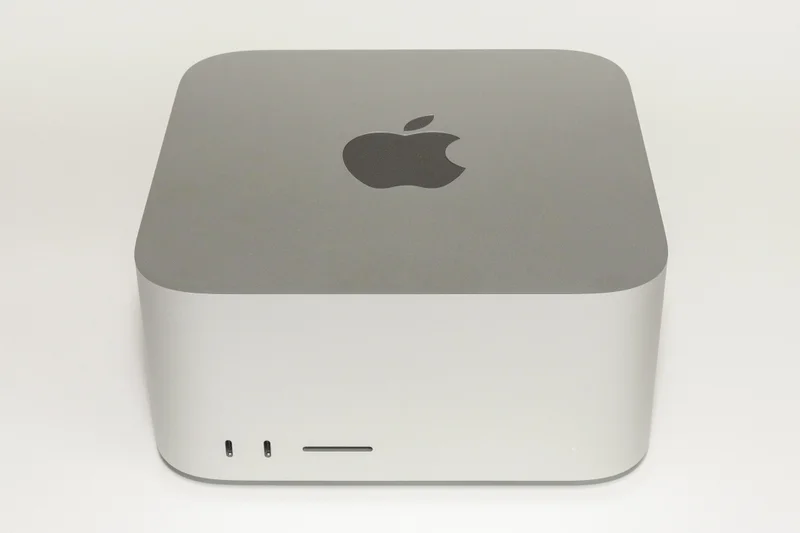
Mac Studio (M1 Ultra, 2022)
New form factor between Mac mini and Mac Pro. M1 Ultra has 20-core CPU and 64-core GPU.
Apple glued two chips together and told the operating system it was one. The M1 Ultra used a silicon interposer called UltraFusion to fuse two complete M1 Max dies, giving up to a 20-core CPU, a 64-core GPU, 128GB of unified memory and bandwidth past 800GB/s. No other chipmaker was shipping anything like it in a consumer or prosumer product. The box was new too. Roughly a Mac mini's footprint and considerably taller, dense with heatsink and two fans, built to hold that performance continuously rather than in bursts. The timing explains why people bought it. The Mac Pro tower had been sitting without an Apple Silicon successor for two years, and editors, 3D artists and audio engineers who needed serious desktop performance had nowhere to go. The Studio matched or beat the Xeon Mac Pro on plenty of real creative work, in a fraction of the volume and noise and often for less money. Reviewers were impressed by the benchmarks and more impressed by the engineering. With the new Studio Display beside it, this filled a gap that had been open since the mini was too weak and the Mac Pro too much.
Mac History Timeline
Full Specifications
Availability
Processor
Memory
Storage
Display
Graphics
Expansion
Connectivity
Physical
Processor Deep Dive
Apple M1 Max / M1 Ultra
AppleM1 Ultra fused two complete M1 Max dies via Apple's custom UltraFusion silicon interposer, appearing to software as a single chip with up to a 20-core CPU and 64-core GPU, delivering multi-chip workstation performance previously unseen in a consumer-oriented desktop. Compared to Intel Xeon-based workstations and AMD Threadripper desktop chips of the era, M1 Ultra offered comparable or superior performance in many creative workloads at dramatically lower power draw and noise. This dual-die fusion technique was a genuine engineering first for Apple, proving unified-memory Apple Silicon architecture could scale well beyond a single chip.
Compatible Operating Systems

macOS Monterey 12.3
Launch OS2022
Launched as the debut OS for the new Mac Studio and M1 Ultra chip.

macOS Ventura 13
Compatible2022
Added Stage Manager and Continuity Camera support later that same year.

macOS Sonoma 14
Compatible2023
Continued full support with desktop widgets and improved gaming APIs.

macOS Sequoia 15
Compatible2024
Brought numerous Apple Intelligence features to this workstation-class Mac.
macOS Sequoia 15
Compatible2025
Remains actively supported and updated as of the most recent macOS releases.
Reviews & Reception
The Mac Studio and its dual-die M1 Ultra chip were met with widespread admiration for delivering workstation-class performance in a strikingly compact new form factor.
Fusing two M1 Max chips together into one is a genuinely audacious piece of engineering, and the resulting performance rivals workstations many times its size.
This fills a real gap in the Mac lineup that's existed for years, serious desktop performance in a compact, quiet chassis, without needing the sprawling Mac Pro tower.
The Mac Studio is exactly the machine prosumers and many professionals have been waiting for. UltraFusion is a legitimately new trick in chip design.
It's compact, it's quiet, and in many creative workloads it beats the far larger, far louder Intel Mac Pro. This is a genuinely new and welcome category for Apple.