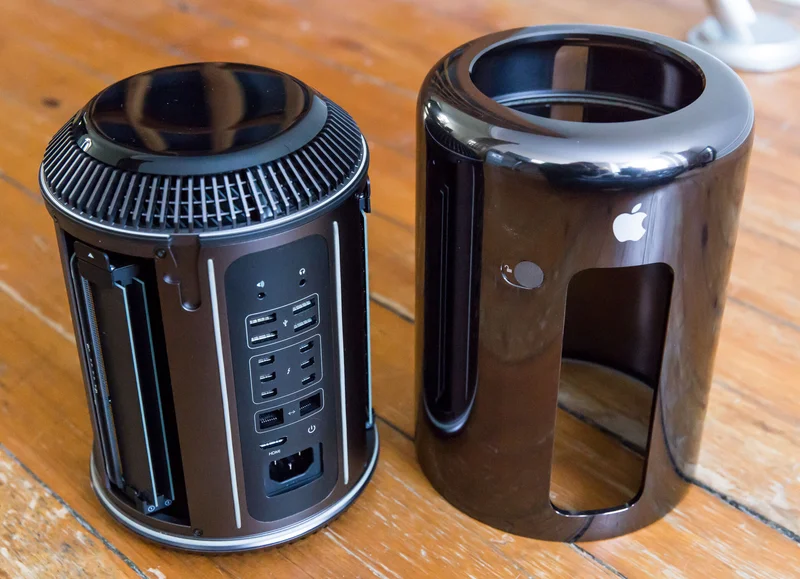
Mac Pro (Late 2013)
The 'trash can' Mac Pro. Radically cylindrical design with dual GPUs. Controversial thermal design.
A black cylinder, machined from one piece of aluminum and polished like a mirror. Everyone called it the trash can within about an hour. Apple built it around a triangular thermal core with one fan pulling air up through the middle, and filled it with Xeon E5 v2 processors up to 12 cores and two AMD FirePro graphics cards as standard. It was roughly an eighth the volume of the tower it replaced and nearly silent. Expansion moved outside entirely, onto Thunderbolt 2. That is where the argument started. Professionals who had relied on internal drive bays, their own choice of graphics card, or PCIe cards suddenly needed expensive external breakout chassis to do things that had been trivial. The second GPU was the deeper problem. Plenty of professional software had not been written for OpenCL or for balancing work across two cards, so it sat idle, and the small thermal core throttled under sustained load. Apple then left it alone for over three years. Video editors, 3D artists and scientists who had been the company's most committed desktop customers drew the obvious conclusion, and in 2017 Apple called a press roundtable to admit the design had not worked.
Mac History Timeline
Full Specifications
Availability
Processor
Memory
Storage
Display
Graphics
Expansion
Connectivity
Physical
Processor Deep Dive
Intel Xeon E5 v2 (Ivy Bridge-EP)
IntelThese server-grade Ivy Bridge-EP Xeon chips offered 4, 6, 8, or 12 cores with support for ECC memory and high memory bandwidth, aimed squarely at professional rendering, video, and scientific workloads. Compared to AMD's Opteron lineup of the time, Intel's Xeon E5 v2 held a commanding lead in per-core performance and efficiency, cementing Intel's dominance in the workstation and server CPU market. The 12-core top configuration was a genuine multi-threaded powerhouse for its era, though the Mac Pro's compact thermal design limited how long these chips could sustain peak boost clocks.
Compatible Operating Systems

OS X Mavericks 10.9.1
Launch OS2013
Shipped as the launch OS for the cylindrical Mac Pro.
OS X Yosemite 10.10
Compatible2014
Brought a visual overhaul that ran well on the Mac Pro's dual-GPU setup.

OS X El Capitan 10.11
Compatible2015
Continued to leverage Metal-era graphics improvements on the dual FirePro GPUs.

macOS Sierra 10.12
Compatible2016
Supported despite the Mac Pro receiving no hardware refresh that year.

macOS Mojave 10.14
Compatible2018
Added dark mode and continued Metal support for the AMD FirePro graphics.

macOS Catalina 10.15
Compatible2019
One of the last releases with full official Apple support for this model.

macOS Monterey 12
Max Supported2021
The final officially supported release; later versions require unofficial patchers.
Reviews & Reception
The 2013 Mac Pro earned admiration for its bold design but drew persistent criticism over thermal throttling and its lack of internal expansion for professional workflows.
It's a stunning object, unlike anything else on a desk, but stunning objects don't always make the best tools for professionals who need to open a case and add a drive.
The dual-GPU architecture is a bet on a software ecosystem that hasn't fully arrived yet, and until it does, many pro users will be paying for horsepower they can't use.
Under sustained heavy rendering loads we saw real thermal throttling, which is a hard thing to forgive in a machine marketed to video professionals.
Apple took a genuine risk here, and you have to respect the engineering ambition even if the execution leaves some pro workflows stranded without their familiar internal expansion.