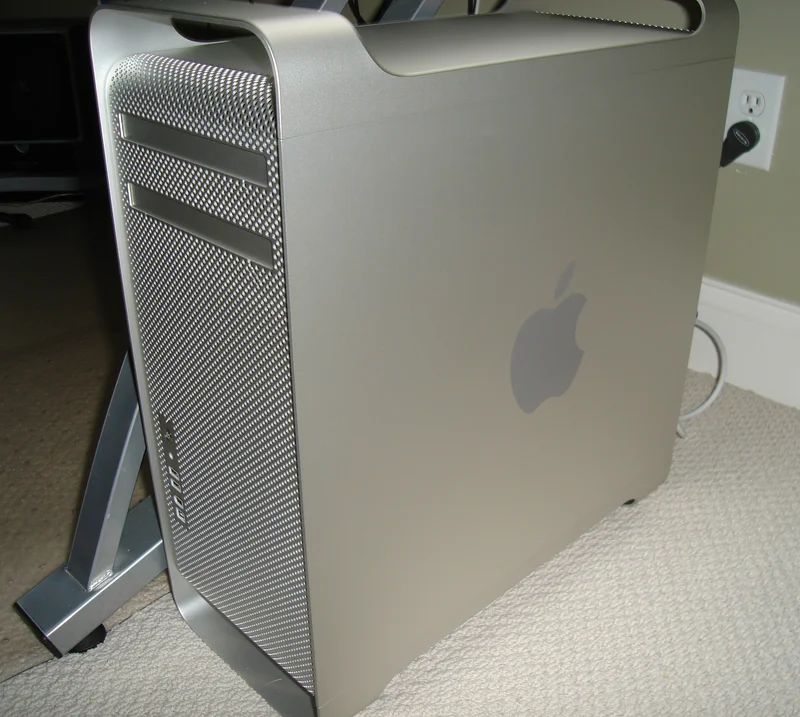
Mac Pro (Early 2009)
First Nehalem Mac Pro. Massive performance leap over previous Xeon Mac Pros.
The Early 2009 Mac Pro moved to Nehalem, which was the most significant thing Intel did to its processors that decade. Xeon 5500 Gainestown chips, four or eight cores depending on whether you bought one processor or two, from 2.26 to 2.93GHz. The architecture put the memory controller on the chip and replaced the front-side bus with QuickPath Interconnect, which cut memory latency sharply, and added Hyper-Threading and Turbo Boost on top. The practical effect was that clock speeds stopped being comparable. This machine beat the 2008 Harpertown Mac Pro substantially on real work while sometimes showing a lower number on the box. Editors, visual effects artists, audio engineers and scientific users noticed immediately in rendering, encoding and anything running many things at once. The tower did not change. Same cheese-grater aluminum, same tool-free bays, same PCI Express slots, all of which is why IT departments liked it and why people upgraded these machines for years instead of replacing them. Reviewers ranked it among the fastest workstations anyone sold. The standing complaints were Apple's RAM prices and what a fully configured one cost, neither of which was new.
Mac History Timeline
Full Specifications
Availability
Processor
Memory
Storage
Display
Graphics
Expansion
Connectivity
Physical
Processor Deep Dive
Intel Xeon 5500 series (Nehalem/Gainestown)
IntelGainestown-based Xeon 5500 processors brought Intel's revolutionary Nehalem architecture to the Mac Pro, introducing an integrated memory controller, QuickPath Interconnect, Hyper-Threading, and Turbo Boost, a combination that delivered dramatic real-world performance gains over the previous Harpertown generation despite comparable clock speeds. This was widely regarded as one of the most significant processor architecture shifts of the era, decisively extending Intel's lead over AMD's competing Opteron workstation chips. Configurations ranged from single quad-core setups up to dual-processor eight-core Mac Pro towers. Nehalem's efficiency and per-core performance gains made this Mac Pro generation a standout even years after its release.
Compatible Operating Systems
Mac OS X 10.5 Leopard
Launch OS2009
Shipped running Leopard 10.5.6.
Mac OS X 10.6 Snow Leopard
Compatible2009
Ran excellently, with Grand Central Dispatch making great use of Nehalem's multi-core and Hyper-Threading capabilities.

Mac OS X 10.7 Lion
Compatible2011
Fully supported and widely used by professionals.

OS X 10.11 El Capitan
Max Supported2015
Commonly cited as the official maximum supported release for this Mac Pro generation.
Reviews & Reception
Regarded as an outstanding, architecturally significant upgrade, with Apple's RAM pricing as the era's recurring complaint.
Nehalem's architectural gains translate directly into faster renders and smoother multitasking, this is a genuinely major upgrade.
Even at similar clock speeds, this Mac Pro trounces last year's model thanks to Nehalem's redesigned memory architecture.
Apple's RAM upgrade pricing remains painfully high, but the processor gains themselves are hard to argue with.
One of the best workstation values you'll find when measured against comparable Windows machines running the same Xeon chips.