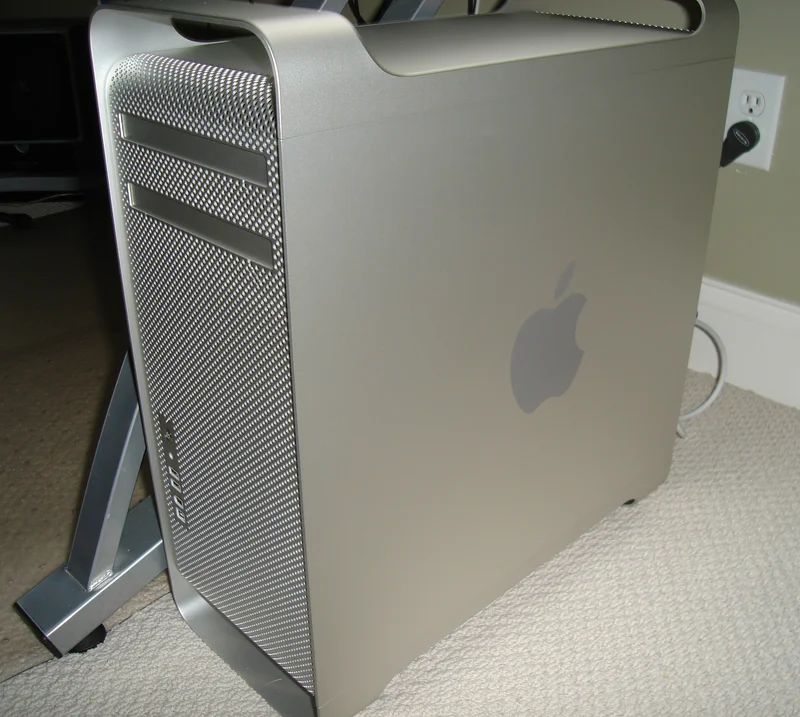
Mac Pro (Early 2008)
Eight-core Mac Pro with dual quad-core Xeons. Massive pro workstation performance.
Eight cores. That is the Early 2008 Mac Pro in two words. Intel's Harpertown Xeons put four cores in each of the tower's two sockets at 2.8 to 3.2GHz, where the 2006 machine had managed two per socket, alongside a faster front-side bus, more and quicker RAM, and professional NVIDIA or ATI graphics as options. For the people it was built for the difference was immediate. Editors cutting HD in Final Cut, 3D artists rendering, scientists running simulations and audio engineers stacking plugin tracks all watched their export times fall sharply. The case was unchanged, which nobody minded. Tool-free drive bays, accessible processor trays and generous PCI Express expansion made it a machine IT departments and power users could actually work on. Reviewers rated it among the fastest workstations available at any price, matching or beating Windows and Linux boxes built on the same Xeons. Fully configured it cost well above an equivalent PC workstation. Apple's professional customers were already committed to Final Cut, Logic and Aperture and mostly paid it. Enthusiasts still name this generation as the high point of the cheese-grater era.
Mac History Timeline
Full Specifications
Availability
Processor
Memory
Storage
Display
Graphics
Expansion
Connectivity
Physical
Processor Deep Dive
Intel Xeon 5400 series (Harpertown)
IntelHarpertown brought quad-core dies to Intel's Xeon workstation lineup, and paired two per Mac Pro for a total of eight cores, a huge multiplier in parallel processing throughput over the previous dual-core Woodcrest generation. Built on Intel's mature 45nm process, it offered improved clock speeds and better power efficiency alongside the doubled core count. It comfortably outperformed AMD's competing Opteron workstation chips of the period in most professional benchmarks. Harpertown-based Mac Pros are still remembered fondly by professionals as remarkably capable, long-lived workstations even years after their release.
Compatible Operating Systems
Mac OS X 10.5 Leopard
Launch OS2008
Shipped running Leopard 10.5.1.
Mac OS X 10.6 Snow Leopard
Compatible2009
Took excellent advantage of eight cores via Grand Central Dispatch.

Mac OS X 10.7 Lion
Compatible2011
Fully supported and widely used by professionals.

OS X 10.11 El Capitan
Max Supported2015
The practical and often-cited official ceiling for this Mac Pro generation.
Reviews & Reception
Received as a decisive, best-in-class workstation upgrade prized for both raw power and its expandable, serviceable design.
Eight cores of Harpertown muscle make this the fastest Mac Apple has ever shipped, and it's not particularly close.
Rendering and export times drop dramatically compared to last year's model; professionals doing heavy video work should take notice.
It's expensive at the high end, but performance-per-dollar against comparable Windows workstations is genuinely competitive.
The tool-free expandability remains a highlight in an era of increasingly sealed, non-upgradeable machines.