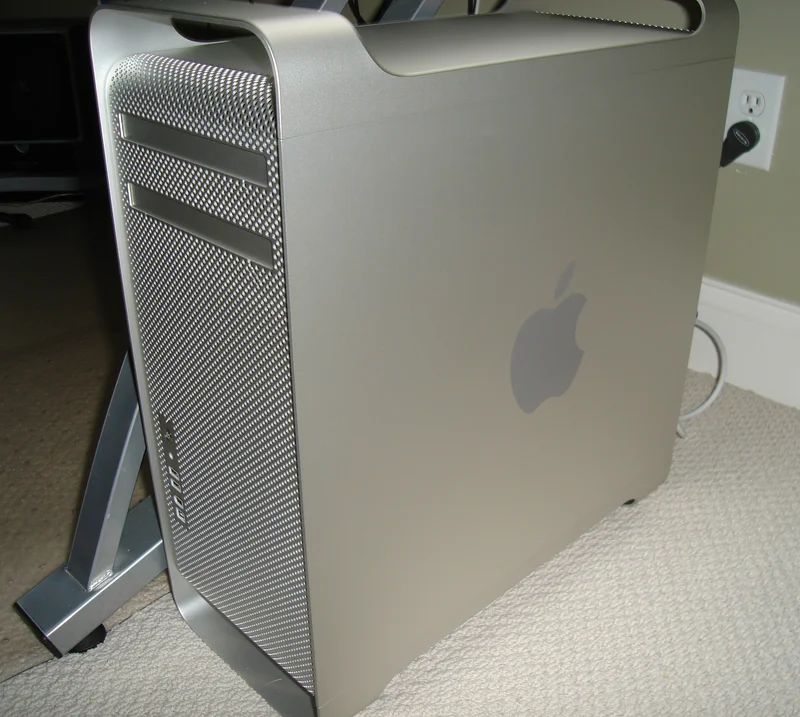
Mac Pro (2006)
Replaced the Power Mac G5. Tower workstation in stunning aluminum chassis with extensive expansion.
The Mac Pro finished the Intel transition in August 2006 by replacing the Power Mac G5, the last PowerPC Mac Apple sold. The case did not change. The same aluminum cheese-grater tower from 2003, with four drive bays, PCI Express slots and RAM and processor trays you could reach without tools. Inside were two Intel Xeon Woodcrest processors, up to four cores across two sockets, from 2.0 to 3.0GHz. Against the Quad G5 it won nearly every professional benchmark, from Final Cut rendering to 3D work to scientific computation, and it ran cooler and quieter doing it. For people who had spent three years waiting on a 3GHz G5 that never came, this was a considerable relief. Boot Camp arrived the same year, so a Mac Pro could also run Windows, which opened it to professionals who needed one Windows-only tool and had been buying a second machine for it. The price was steep and PowerPC-optimized software still had to catch up. Almost nobody mourned the G5. This enclosure then ran until 2012, when Apple replaced it with the cylinder.
Mac History Timeline
Full Specifications
Availability
Processor
Memory
Storage
Display
Graphics
Expansion
Connectivity
Physical
Processor Deep Dive
Intel Xeon 5100 series (Woodcrest)
IntelWoodcrest was Intel's server/workstation-class derivative of the Core microarchitecture, delivering major gains in performance-per-watt over the previous NetBurst-based Xeons and over IBM's PowerPC G5. Running in pairs, Mac Pro configurations offered up to four physical cores total, a huge jump in professional workload throughput. It was widely regarded as class-leading against AMD's Opteron workstation chips at the time thanks to Intel's efficiency advantage from the new Core architecture. Woodcrest effectively proved Intel had regained the workstation performance crown after several years of AMD Opteron dominance.
Compatible Operating Systems

Mac OS X 10.4 Tiger
Launch OS2006
Launched on Tiger 10.4.7 Server-derived build for Intel Xeon.
Mac OS X 10.5 Leopard
Compatible2007
Fully supported, with better multi-core scheduling for dual-Xeon setups.
Mac OS X 10.6 Snow Leopard
Compatible2009
Ran well, benefiting from 64-bit kernel and Grand Central Dispatch multicore improvements.

Mac OS X 10.7 Lion
Max Supported2011
Final officially supported OS for the original 2006 Woodcrest Mac Pro.
Reviews & Reception
Hailed as a decisive, overdue performance triumph that closed out the PowerPC era on a high note.
The Mac Pro doesn't just replace the Power Mac G5, it embarrasses it, delivering performance the PowerPC platform simply couldn't reach.
Dual Xeon Woodcrest chips make this the fastest Mac ever built by a wide margin, and one of the fastest workstations available at any price.
Expandable, powerful, and now finally competitive with Windows workstations on raw benchmarks, the Mac Pro is everything pros wanted from the G5.
It's expensive, but for creative professionals the performance-per-dollar math finally favors Apple.