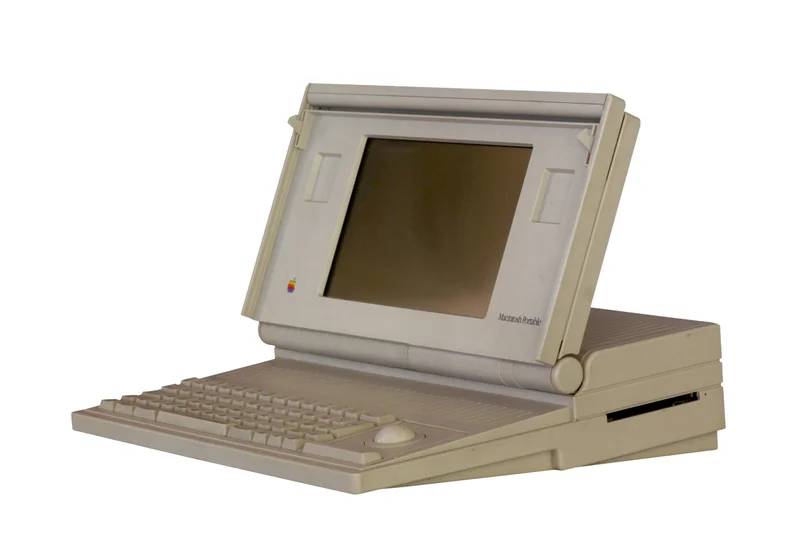
Macintosh Portable
Apple's first battery-powered Mac. Extremely expensive and heavy, but with an impressive 10-hour battery life and the first backlit Mac display.
Apple shipped its first battery-powered Mac on September 20, 1989. It weighed 16 pounds. The nickname that stuck was luggable, and it was fair, though what Apple got right was the screen and the battery. A backlit active-matrix black and white display, crisp and readable at a time when most portable computers made do with passive-matrix or plasma panels that smeared. A sealed lead-acid battery ran it for around ten hours, which no laptop would match for years, and that battery is also most of the 16 pounds. The 68000 ran at 16MHz, twice the speed of the compact Macs using the same chip family. A trackball sat beside the keyboard rather than clipping on as an afterthought, and the keyboard itself felt close enough to a desktop one that reviewers kept saying so. Then there was the price, and the weight, and a battery you could not swap without opening the machine. Reviewers praised the screen and the endurance and then asked who exactly was carrying this, while Toshiba and Compaq were selling lighter machines that did less. It sold badly. Apple took the screen quality, the trackball placement and the keyboard into the PowerBook 100 two years later and left the lead-acid battery and the bulk behind, which is the useful thing the Portable did.
Mac History Timeline
Full Specifications
Availability
Processor
Memory
Storage
Display
Graphics
Expansion
Connectivity
Physical
Processor Deep Dive
Motorola 68000
MotorolaThe Portable used a 16MHz variant of the venerable 68000, a notable speed bump over the 7.83MHz chips used in Apple's contemporary compact desktop Macs while retaining full software compatibility with the existing Mac ecosystem. Its CMOS fabrication, as opposed to the older NMOS process used in earlier 68000 implementations, helped reduce power consumption, an important consideration for a battery-powered machine. Despite the useful clock speed increase, the chip remained architecturally identical to the original 1979 design, lacking the integrated MMU and improved instruction set of the newer 68030 already shipping in Apple's high-end desktop Macs. It represented a reasonable compromise between performance and power efficiency for Apple's first battery-powered machine.
Compatible Operating Systems
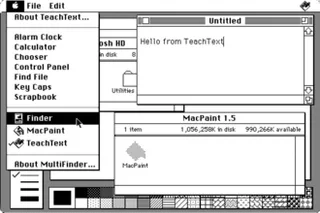
System 6.0.4
Launch OS1989
Shipped with the Portable, tuned for its battery-powered operation and active-matrix display.
System 6.0.8
Compatible1991
The final and most refined System 6 release compatible with the Portable's hardware.

System 7.0
Max Supported1991
Ran on Portables with expanded RAM, though performance was limited by the 68000 CPU.
Reviews & Reception
Praised for its screen, keyboard, and battery life but widely criticized for excessive weight and price, seen as an ambitious but flawed first attempt at Mac portability.
The Portable's screen and keyboard are the best we have seen on any battery-powered computer, but nearly sixteen pounds strains the definition of portable.
Ten hours of battery life and a genuinely readable active-matrix display are remarkable achievements, undermined by considerable bulk and a steep price.
Business travelers hoping for a lightweight companion will be disappointed, though the trackball and keyboard quality are without peer.
An impressively engineered but ultimately impractical first attempt at a portable Mac, one that clearly needs a lighter second generation.